

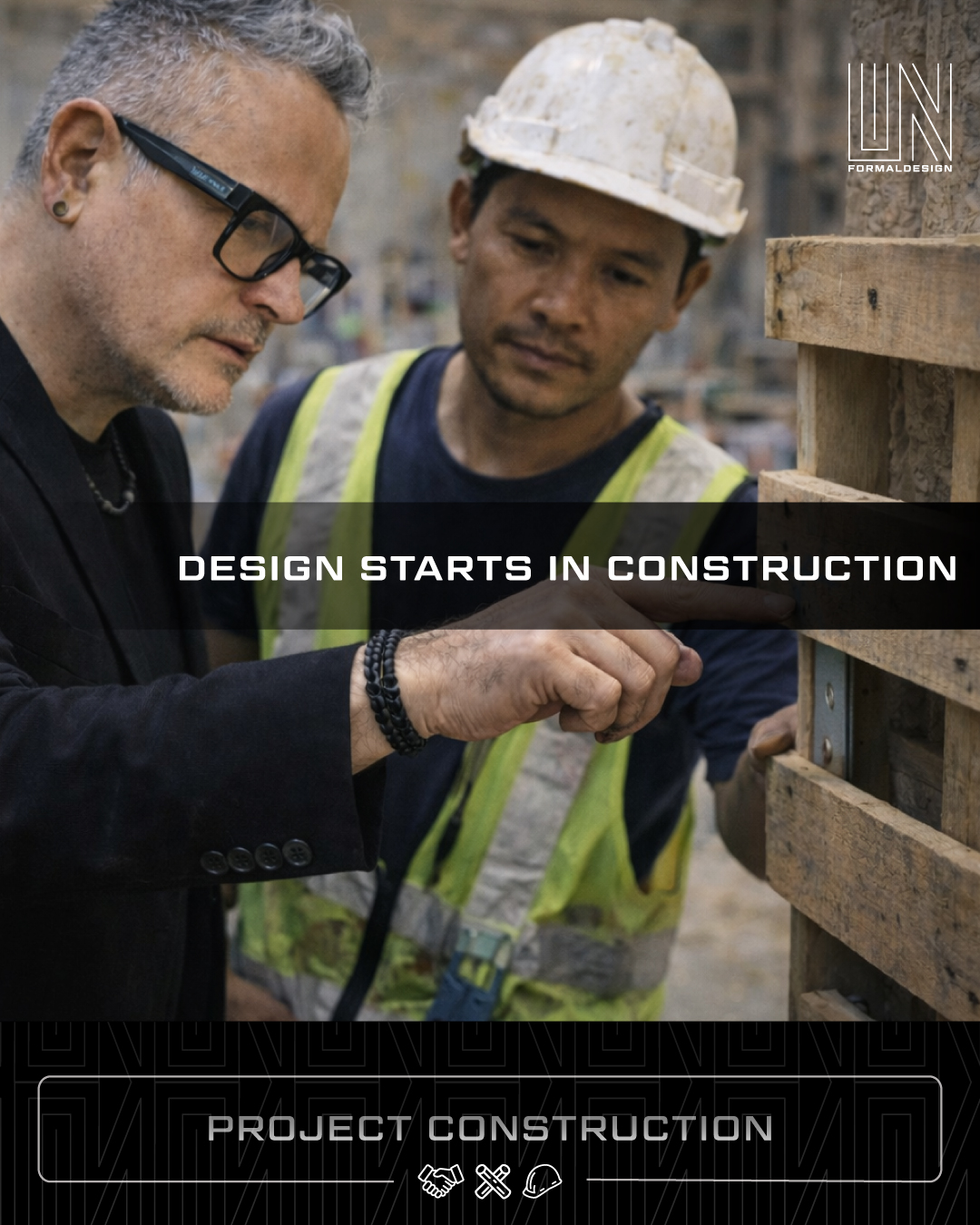
Most people talk about construction as if it were the boring part that happens after the creative work is done. We see it differently. Construction is where the design either becomes real or falls apart. Drawings are hypotheses. Renders are promises. Site conditions are reality. That is why we do not treat construction as a handover phase. We treat it as the beginning of the project’s real life.
A hospitality interior only starts speaking properly when the work moves onto site. Measurements stop being abstract. Materials stop being theoretical. Light starts revealing what the drawings could not. The contractor notices tolerances no one saw on screen. A plaster sample behaves differently in humidity. A junction that felt elegant on paper suddenly feels too heavy at full scale. These are not problems to hide from. They are the moment the project becomes honest.
About UNFORMALDESIGN: https://unformaldesign.com/about/ | Material System: https://unformaldesign.com/material-system/
Internal link placements: UNFORMALDESIGN approach → https://unformaldesign.com/about/ | material system learning → https://unformaldesign.com/material-system/ | UNFORMALDESIGN home → https://unformaldesign.com/
This is why we treat every build as construction phase hospitality design, not just project management. Site led interior design is where hospitality fit-out process decisions, material testing on site, and operational reality turn a concept into something durable enough for real restaurant build quality.
Why site is part of the design process
We stay close to construction because atmosphere is not something you can fully design from a desk. Hospitality is built through sequence, tactility, proportion, light, sound, and movement. Those things become clear when bodies move through a real space, not just when eyes look at a render. We need to feel the compression at the entrance. We need to see how warm light lands on raw plaster. We need to understand whether the service path actually works at speed.
This is why construction matters:
– It exposes what is essential and what was only decorative.
– It forces decisions about proportion, rhythm, and service.
– It reveals the real behaviour of materials under local conditions.
– It aligns designers, contractors, and operators around one reality.
– It turns vague intention into buildable atmosphere.
Testing, adjusting, refining
The site is our testing ground. We mark bar heights in real scale. We check how a feature wall meets a floor edge. We review whether a lighting slot is too sharp or too soft. We adjust details before they become expensive mistakes. That process is not a sign that the design was weak. It is a sign that the design is alive.
Things we test on site:
– Lighting temperatures and beam spread.
– Material junctions and tolerance gaps.
– Circulation between guest zones and staff zones.
– Surface finishes under natural and artificial light.
– Visibility of signage, menu points, and focal objects.
– Practical details such as cleaning access and maintenance logic.
The best hospitality spaces are not frozen concepts. They are refined through real feedback. A contractor’s comment can sharpen a detail. A service rehearsal can change a counter depth. A site mock-up can prove that one finish should be rougher, or warmer, or less perfect. Those revisions are not compromises. They are how the project becomes more itself.
Construction builds the emotional layer
People often think emotion in design comes from styling. It does not. It comes from the right relationships between scale, material, light, and movement. Construction is where those relationships are tuned. A small shift in a lighting line can make a wall feel intimate instead of flat. A slightly rougher finish can make a space feel more human. A better-resolved edge can make the whole room feel more intentional.
That emotional layer depends on presence. We want the crew, the contractor, and the operator to understand the atmosphere we are trying to build. When everyone sees the same goal, the project gains coherence. The work stops being a checklist and becomes a shared act of making.
What we protect during construction:
– The clarity of the guest journey.
– The contrast between raw and refined.
– The durability of materials in Thai climate conditions.
– The integrity of the lighting concept.
– The operational logic behind the bar, kitchen, or service route.
– The tactile identity that makes the space memorable.
From one site to the next
Construction is also where our design DNA evolves. Every site teaches us something. A better metal detail. A smarter module. A more resilient finish. A lighting trick that works beautifully in humid air. Those lessons do not disappear when the project opens. They feed back into the next project through our broader material system and design process. That is how experimentation becomes knowledge, and knowledge becomes repeatable quality.
This is especially important in hospitality and F&B work in Thailand, where climate, use intensity, and site constraints demand more than pretty ideas. Tropical heat, humidity, salt air, heavy traffic, fast service, changing concepts—these all put pressure on the build. If the construction phase is treated like a formality, the project weakens. If it is treated as part of the design, the project gains depth and resilience.
Construction is where design stops performing and starts proving itself. It is where the venue finds its final atmosphere, not because the drawings were wrong, but because the site allowed the right decisions to emerge. That is why we stay close, document the lessons, and treat the field as part of the studio.
If you are planning a hospitality or F&B project in Thailand and want the site process to strengthen the concept instead of diluting it, involve the design conversation early and keep it alive through the build. That is where the real work begins.
If you want a space that still feels alive after the dust settles, let’s build it properly. WhatsApp: https://wa.me/66971123561 | Email: mailto:alessio@unformaldesign.com
Comments