



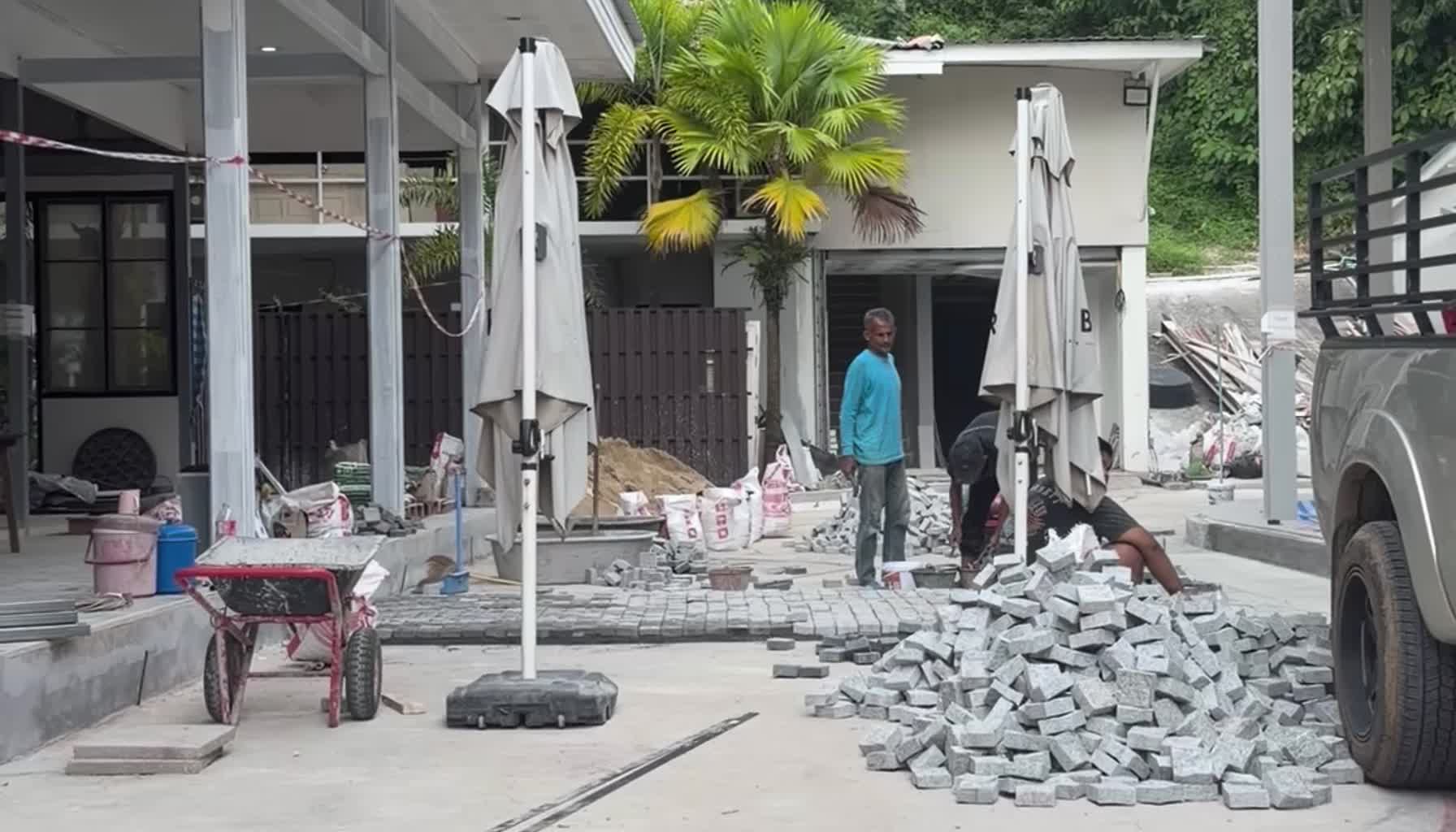
Paving design is the plan of a walking surface: which material and finish it uses, how it is laid and which way the water runs off it. In a tropical pedestrian lane or restaurant terrace, three factors decide almost everything: slip resistance when the surface is wet, drainage during monsoon downpours, and heat under the midday sun. UNFORMALDESIGN is a Bangkok-based interior design and architecture studio, led by Italian architect Alessio Carta, that designs hospitality, retail and F&B spaces across Thailand. On YOLO Krabi Lifestyle Lane in Ao Nang, a concept design by the studio for an existing retail and F&B street, the new ground is now going down on site: grey stone pavers, laid by hand, row by row. This article explains the technical choices behind outdoor paving in Thailand, with the numbers designers and owners should ask for.
What makes outdoor paving safe when it rains?
Outdoor paving is safe when wet if its slip resistance stays high with water on the surface. In the UK, where the method is standard, a wet Pendulum Test Value (PTV) of 36 or more means low slip potential, 25 to 35 moderate and 24 or less high, according to the Health and Safety Executive and the UK Slip Resistance Group.
Other countries use other scales. Germany’s DIN 51130 ramp test sorts floors from R9 to R13 by the angle at which a shod walker slips on an oily ramp, and the HSE notes that R9, and sometimes R10, can be slippery when wet. German workplace rules call for R11, or R10 with drainage space, on outdoor walkways and entrances. The American standard ANSI A326.3 sets a wet dynamic coefficient of friction of 0.42 for level interior floors, but leaves exterior wet values to the manufacturer to declare.
The finish often matters more than the stone. In a 2021 laboratory study published in the journal Materials, polished granite scored a wet slip value of 22, in the high-risk band, while flamed, brushed and grained finishes of the same granite all scored above 36.
| Surface finish | Wet slip result | Use outdoors? |
|---|---|---|
| Polished stone | High slip potential (wet value around 22) | No, keep it indoors and dry |
| Honed or smooth sawn | Varies by stone, test before specifying | Only under cover |
| Flamed | Low slip potential (above 36) | Yes |
| Brushed or bush-hammered | Low slip potential (above 36) | Yes |
| Textured concrete pavers | Depends on product, ask for the test value | Yes, if the value is declared |
How should paving drain in a Thai monsoon?
Paving in Thailand must shed very large volumes of water fast. Krabi receives about 2,181 mm of rain a year on 172 rain days, with August to October the wettest months, and Koh Samui about 1,994 mm, with November alone averaging 445 mm, according to the Thai Meteorological Department’s 1991 to 2020 climate normals.
Single days can be extreme: Samui’s records include 414.7 mm in one day. Paving therefore needs a fall built into the base, not just the surface. UK supplier guidance for natural stone recommends a cross-fall of 2.5% (1 in 40) and a longitudinal fall of 1.25% (1 in 80), and the Interlocking Concrete Pavement Institute sets a minimum slope of 1.5% for concrete pavers.
Permeable paving is the other route: water passes through the joints into a stone base below. The British industry guide from Interpave expects a new permeable surface to take at least 2,500 mm of water per hour, but whether the water can then soak into the ground depends on the soil, and the groundwater must sit at least 1 metre below the base. Permeable systems are designed for concrete blocks with gravel joints, not for stone slabs set in mortar, so the decision is made at concept stage, not on site.
| Location | Annual rainfall | Wettest months | Highest daily rainfall on record |
|---|---|---|---|
| Krabi | 2,180.7 mm | October, September, August | 161.4 mm |
| Koh Samui | 1,994.3 mm | November, October, December | 414.7 mm |
Rigid or flexible: how should stone pavers be laid?
Stone pavers are laid either rigid, on a mortar bed over a concrete base, or flexible, on a bed of compacted sand with an edge restraint. Rigid laying gives a firm, continuous surface; flexible laying is cheaper to repair but can rock if water washes the sand away.
| Rigid (mortar on concrete) | Flexible (sand bed) | |
|---|---|---|
| Base | Concrete slab, typically 100 to 150 mm | Compacted aggregate |
| Bedding | Mortar, about 30 to 40 mm | Sand, about 25 to 40 mm |
| Joints | At least 10 mm, mortar filled | 2 to 5 mm, sand filled |
| Movement joints | Needed, often around every 6 m in sun or large areas | Not usually needed |
| Main risk | Cracking if water and movement are ignored | Rocking units if water moves the sand |
| Repair | Harder, units must be broken out | Easier, units can be lifted and relaid |
The figures come from UK installation guidance by Marshalls and the PavingExpert reference site. On YOLO, the grey stone pavers are being set by hand on a concrete base under the covered walkway of the lane, row by row. The stone type and size are not published, so this article does not claim them.
How hot does paving get in the sun?
Conventional paving can reach 48 to 67 degrees Celsius at its peak in summer, according to the US Environmental Protection Agency, and the colour of the surface is the main factor in how hot it gets. Dark materials absorb more sun; light ones reflect more of it.
In a 2021 field study of concrete pavers in Sri Lanka, a tropical climate close to Thailand’s, grey pavers stayed up to 4.5 degrees Celsius cooler than black ones at peak, and red pavers up to 4.2 degrees cooler. For a beach town, where guests walk in sandals or barefoot, choosing a light or mid-tone surface and adding shade is part of the comfort brief. A covered walkway, like the one along YOLO, also keeps direct rain and sun off the surface.
Why does paving design matter to a lane or terrace?
Paving matters because it is the one surface every visitor touches. On a street of separate shopfronts, a single continuous ground turns many frontages into one walk; that is the role of the paving on YOLO Krabi Lifestyle Lane, where the concept design ties existing tenants such as El Gaucho Steakhouse Argentino, Sati and Tribe into a single “sea to mountain” journey through Ao Nang.
The same logic applies to a restaurant terrace in Bangkok or a beach club deck on Koh Samui: the floor decides how the space reads before any furniture, lighting or signage arrives. For concrete paving blocks, Thailand has its own industrial standard, TIS 827, for interlocking concrete paving blocks; for natural stone, the slip, drainage and laying questions above are the checklist.
Frequently Asked Questions
What is the best paving for an outdoor restaurant terrace in Thailand? The best terrace paving combines a textured finish that stays slip resistant when wet, such as flamed or brushed stone, with a built-in fall that drains rain quickly. Light or mid-tone colours stay cooler in the sun. Avoid polished stone outdoors: in laboratory tests polished granite fell into the high slip risk band when wet.
What slip resistance should outdoor paving have? In the UK method, outdoor paving should reach a wet Pendulum Test Value of 36 or more, which the Health and Safety Executive classes as low slip potential. On the German DIN 51130 scale, workplace rules call for R11, or R10 with drainage space, on outdoor walkways. Ask the supplier for a test value on the exact finish being specified.
What gradient does outdoor paving need to drain? Paving needs a fall built into its base so water runs off rather than pooling. UK guidance for natural stone recommends a cross-fall of 2.5%, or 1 in 40, and a longitudinal fall of 1.25%, or 1 in 80. The Interlocking Concrete Pavement Institute sets a minimum slope of 1.5% for concrete pavers.
Is permeable paving a good idea in Thailand? Permeable paving can help during heavy rain because water drains through the joints into a stone base, and new surfaces can take at least 2,500 mm per hour. It only works where the soil can absorb the water and groundwater sits at least 1 metre below the base. It is designed for concrete blocks with gravel joints, not mortar-set stone.
Does UNFORMALDESIGN design outdoor lanes and terraces in Thailand? Yes. UNFORMALDESIGN is a Bangkok-based interior design and architecture studio led by Italian architect Alessio Carta. It designs restaurants, beach clubs, hotels and retail streets across Thailand, including the concept design for YOLO Krabi Lifestyle Lane in Ao Nang and SATI in Ao Nang. Contact alessio@unformaldesign.com or WhatsApp +66 97 112 3561.
The takeaway
Good paving design in Thailand answers three questions before choosing a colour: will it grip when wet, where will the monsoon water go, and how hot will it get underfoot. On YOLO Krabi Lifestyle Lane, the answer is being built by hand, one row of grey stone at a time, as one continuous ground for the whole street.
Internal links: /retail-lane-design-ao-nang-krabi-yolo/ (YOLO Krabi Lifestyle Lane) · /interior-design-ao-nang-krabi-sati/ (SATI Ao Nang) · /restaurant-interior-design-bangkok/ (restaurant interior design in Bangkok) · /interior-design-koh-samui/ (interior design on Koh Samui) · /beach-club-design-koh-samui-socialtel-day-night/ (Socialtel beach club, Koh Samui) · /material-system/ (UNFORMALDESIGN Material System)