

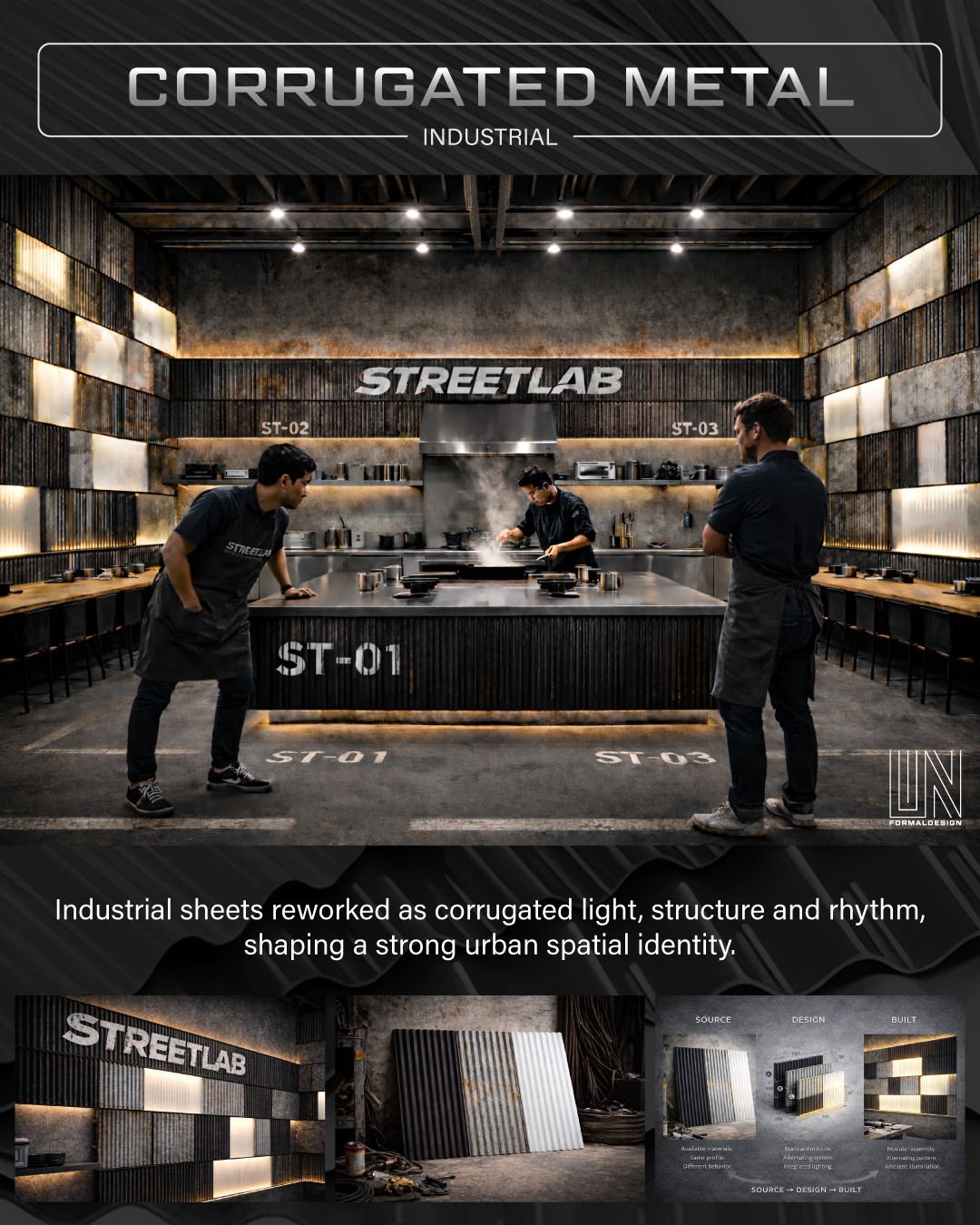
Corrugated metal is not just cladding. In the right hands, it becomes a spatial language—a way to bring the intelligence of the street into a hospitality interior without turning the venue into a caricature of “industrial style.” We see corrugated metal every day in Thailand: temporary enclosures, rooftops, food stalls, improvised repairs, storage walls, shaded service lanes. It is part of the visual grammar of the city. The point is not to copy that grammar literally, but to frame it with discipline so it becomes architecture.
When we use corrugated sheets inside a bar, café, restaurant, or hotel project, we are not chasing roughness for its own sake. We are working with rhythm, reflectivity, shadow, and durability. The ridges hold light in a specific way. The repeated profile creates a pattern that can feel utilitarian, calm, aggressive, or elegant depending on how it is cut, finished, lit, and paired with other materials. That is why corrugated metal matters to us: it gives us a raw language that can still be refined.
About UNFORMALDESIGN: https://unformaldesign.com/about/ | Material System: https://unformaldesign.com/material-system/
Internal link placements: material system experiments → https://unformaldesign.com/material-system/ | built hospitality projects → https://unformaldesign.com/projects/ | design philosophy → https://unformaldesign.com/about/
In strategic terms, this is corrugated metal hospitality interior design: using an industrial surface not as a gimmick, but as a repeatable, street-inspired material system for bars, restaurants, and other hospitality settings in Thailand. When rhythm, lighting, and detailing are resolved properly, a restaurant metal feature wall or bar skin becomes far more than cladding. It becomes one of the clearest examples of how industrial interior design Thailand venues can use still needs discipline to feel premium.
Why corrugated metal works in hospitality
Hospitality needs surfaces that do more than look interesting on opening night. They need to survive hands, spills, heat, cleaning, humidity, and changing operational needs. Corrugated metal already comes with a structural logic. It is lightweight, modular, easy to source, relatively efficient to install, and capable of carrying visual character without needing decorative overload. In other words: it can do real work.
What we like about it:
– The profile catches grazing light and creates instant depth.
– Standard modules help reduce waste and simplify installation.
– The surface can feel raw, polished, oxidised, or almost graphic depending on finish.
– It works as wall cladding, bar skin, ceiling insert, partition, or service wrap.
– It can age well if the detailing is honest.
– It already belongs to the visual culture of the street.
Street language, but controlled
The danger with corrugated metal is obvious: it can become cheap, noisy, or fake very quickly. That happens when it is used as a costume. We prefer to treat it as a system. That means setting a corrugation pitch, selecting panel dimensions, resolving how corners meet, deciding where the rhythm should stop, and understanding how lighting will animate the ridges. The result is less “look at this tough material” and more “this surface belongs here.”
We also care about what sits next to it. Corrugated metal gets stronger when it is offset by warmer, softer, or more tactile elements. Plaster, timber, hand-painted graphics, textured concrete, warm light, soft upholstery—these contrasts stop the metal from becoming one-note. Hospitality is always about balance. Too much rawness becomes fatigue. Too much polish becomes generic. Corrugated metal sits well in the middle if the composition is right.
How we deploy the system
We think of corrugated metal as a kit of parts. A wall can become a rhythm field. A bar front can take on a tougher, more urban character. A corridor can gain shadow and direction. A ceiling feature can carry sound and light differently. Because the sheet profile is repetitive, it naturally creates order. The trick is knowing where to break that order.
Ways we use the system:
– Bar fronts with integrated kickplates and concealed lighting.
– Feature walls where shadows shift through the day.
– Ceiling bands that compress or release a zone.
– Semi-open partitions that frame circulation.
– Service wraps that disguise technical areas without flattening them.
– Backdrops for signage, menus, or bottle displays.
This matters especially in Bangkok and other dense Thai urban contexts, where venues often need atmosphere without huge floor areas. Corrugated metal can create impact without stealing too much depth. It can help a small venue feel sharper and more deliberate, especially when paired with light and graphic rhythm.
Operational logic matters
A hospitality material is only useful if it respects service. Can staff clean it easily? Does it scratch in a way that becomes character rather than damage? Can one panel be replaced without ripping out an entire wall? Does it sit safely around traffic-heavy corners? These questions matter more than mood boards.
That is why we prefer mechanical logic over decorative improvisation. When the detailing is resolved properly, corrugated metal is practical:
– Panels can be standardised for future replacement.
– Junctions can be designed to reduce dirt traps.
– Lighting can be hidden inside the ribs or edges.
– Protective finishes can preserve character without sterilising the material.
– The same module can reappear across multiple zones for brand consistency.
This is where the material starts becoming part of a broader system rather than a one-off move. We document those details because they are transferable. A solution tested in one F&B venue can evolve into a stronger solution for the next project.
From raw sheet to atmosphere
The real transformation happens with light. Corrugated metal is never just a surface; it is a light instrument. Warm grazing light makes it feel cinematic. Colder directional light makes it feel sharper, more energetic, more nightlife. Low-angle illumination exaggerates the ridges and turns a flat wall into a deep backdrop. That means the metal is not doing the work alone—material and lighting are one decision.
We also use corrugated metal because it can hold contradiction well. It can feel rough but composed. Cheap in origin, sophisticated in use. Familiar from the street, but transformed through proportion and discipline. That contradiction is exactly where many hospitality brands come alive. They do not want corporate perfection. They want character that still functions under pressure.
Part of a larger material system
We do not isolate corrugated metal as a trend. It sits inside the broader experimentation we keep building through our material system approach: modules, repeatable details, adaptable surfaces, and combinations that are expressive but still buildable. The point is to create a language that can move from one project to the next without becoming copy-paste. You can explore that logic further here: https://unformaldesign.com/material-system/
If you are building a hospitality space in Thailand and want something urban, tactile, and durable without falling into cliché, corrugated metal can be a powerful move—if it is framed properly. That is the difference between decoration and design.
If you want a venue that feels street-rooted but operationally sharp, let’s talk early. WhatsApp: https://wa.me/66971123561 | Email: mailto:alessio@unformaldesign.com