


Ceilings usually disappear into the background unless they are trying too hard not to.
Either they stay blank and generic, or they become a big formal gesture that dominates the room but does not really deepen the atmosphere.
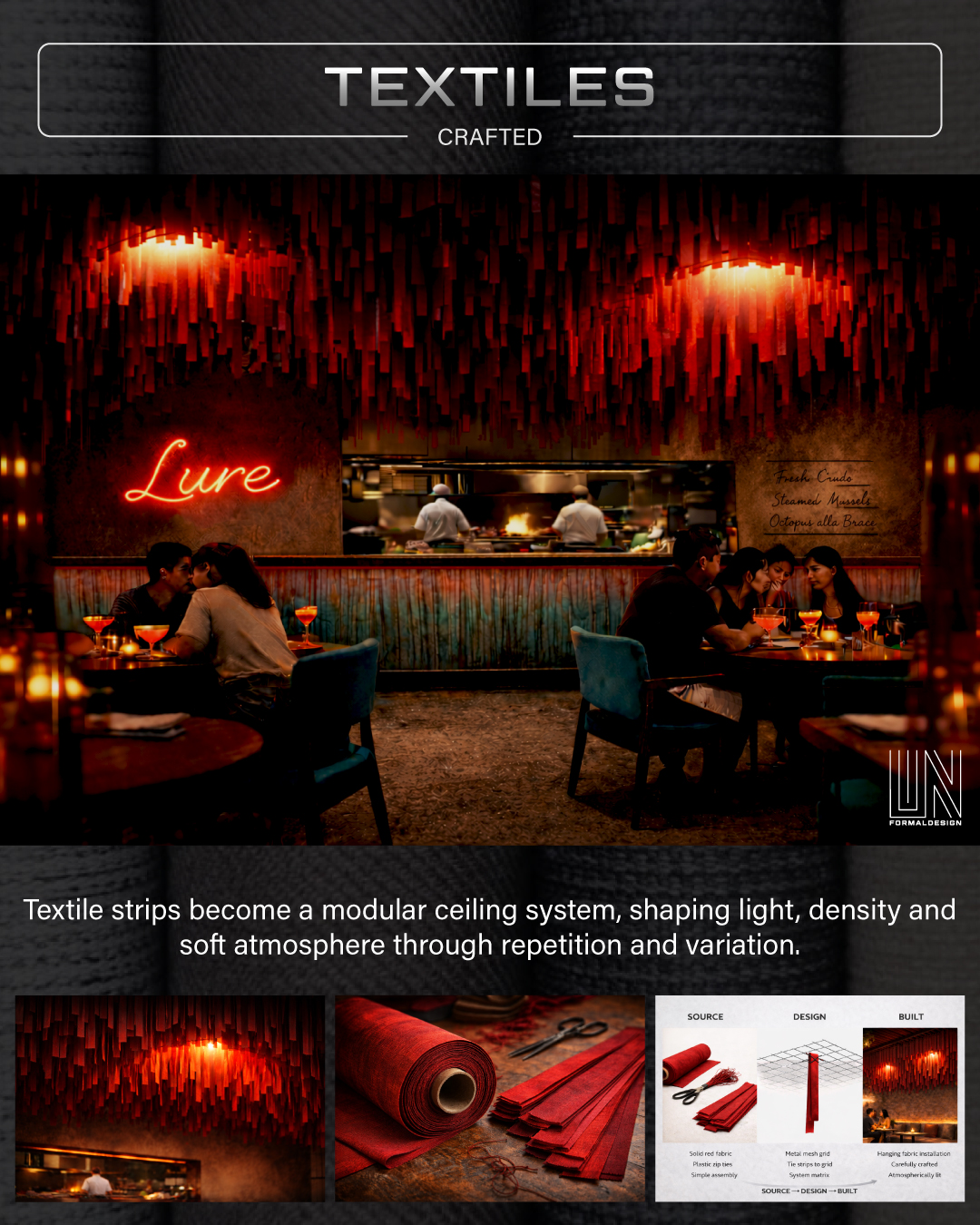
This system takes a quieter route. It starts from a simple textile strip and builds a ceiling through repetition, variation, and light.
UNFORMALDESIGN uses a metal mesh grid as the logic underneath, because experiential interior design often works best when the atmosphere starts overhead rather than on the walls. The strips shift in length and density so the field moves from open to compressed. The ceiling becomes less like a flat plane and more like a soft gradient overhead.
About UNFORMALDESIGN: https://unformaldesign.com/about/ | Material System: https://unformaldesign.com/material-system/ | Projects: https://unformaldesign.com/projects/
The result is not loud. That is exactly why it works. Hidden light filters through thinner areas and creates irregular glow instead of uniform brightness. The atmosphere feels softer, more tactile, and more spatial without relying on expensive complexity.
Why the system works
The power comes from three things lining up at the same time:
\- repetition gives the ceiling order;
\- variation gives it life;
\- concealed light gives it emotional range.
If all three are balanced, the room gains depth and rhythm without the ceiling trying to perform like sculpture.
That is what makes it useful in hospitality. Guests feel it before they consciously read it.
Where it can work best
A textile ceiling system makes sense where the room needs softness overhead:
- above lounge seating where glare needs to drop;
- over a dining zone that needs calmer, lower light;
- in a hospitality lobby where the ceiling can guide direction subtly;
- in nightlife or hybrid spaces where density and glow need to change the energy without hard architectural moves.
It is a flexible strategy because the logic is modular even if the final reading feels organic.
What to watch in the detailing
This kind of system only feels good when the restraint is real.
Questions that matter:
\- is the density shift smooth or arbitrary?
\- can the strips age and be cleaned without becoming messy?
\- is the light too even, too bright, or too cold?
\- does the grid disappear enough for the fabric and glow to carry the mood?
Those details decide whether the ceiling feels atmospheric or just crafty.
Thailand reality check
Fabric overhead in Thailand needs practical thinking. Heat, dust, humidity, and maintenance all matter. The system has to stay easy enough to service or replace in parts.
That is the tradeoff worth managing. The mood can be soft and poetic, but the build has to stay realistic.
Working with UNFORMALDESIGN
If you’re planning a restaurant, lounge, hotel, or hospitality venue in Thailand and want a ceiling strategy that feels atmospheric without becoming over-designed, message us.
\- WhatsApp: +66 97 112 3561 — https://wa.me/66971123561
\- Email: alessio@unformaldesign.com
Send the venue type, ceiling height, and whether the room needs to feel calmer, warmer, or more immersive.