

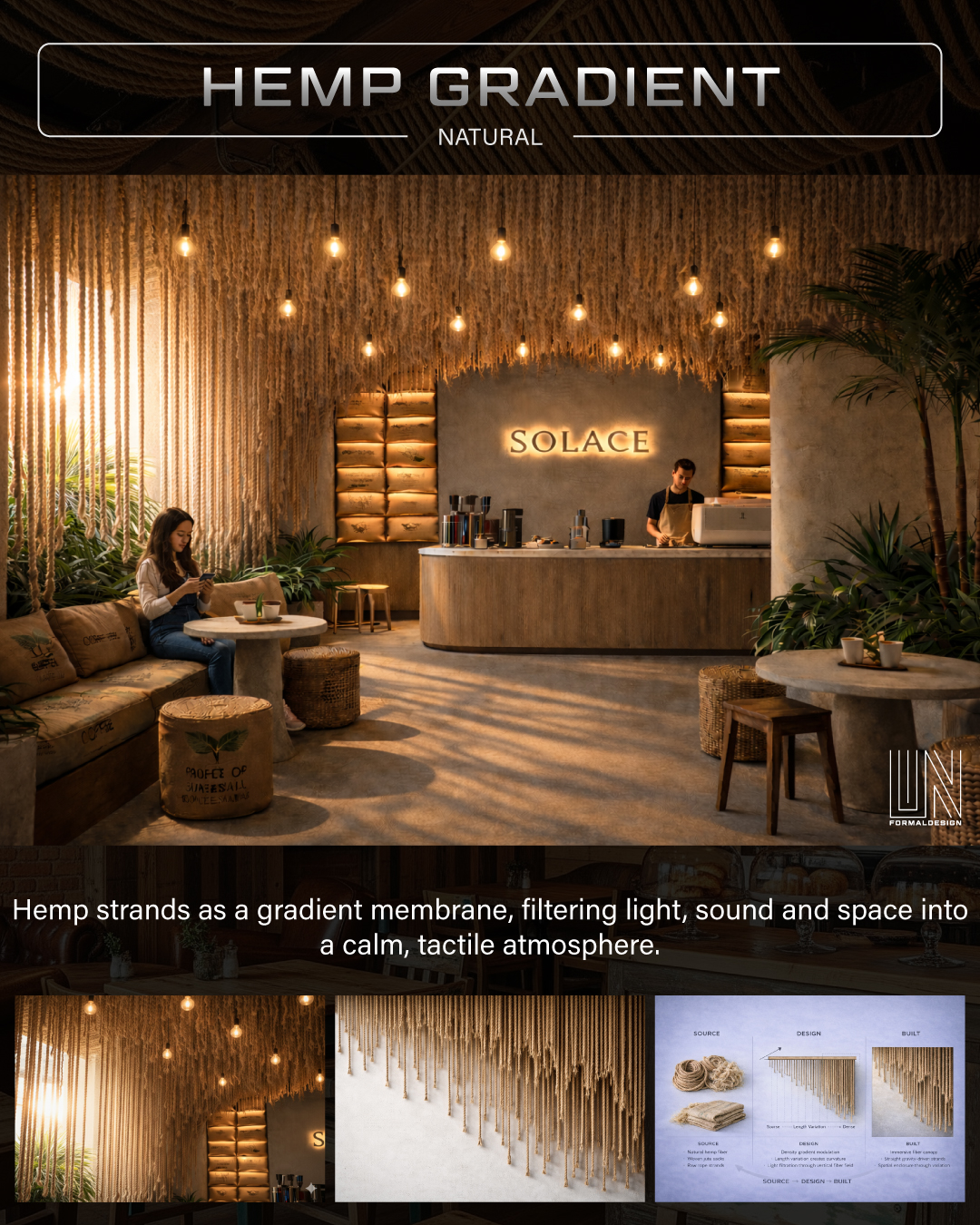
The Hemp Gradient System is a tactile field that wraps a space without slamming the door. Thin vertical strands of hemp fall from the ceiling like a curtain, but they are not a curtain—they are a choreographed modulation of density, rhythm, light, and softness. When we stretch the strands in a gradual gradient from sparse to dense, we shape pockets of intimacy, glimpses of movement, and breaths of air. It is an enclosure you can see through while still feeling embraced, a physical organ that guides guests without taking over the scene.
Hemp is the star. We treat it as structural texture, not textile afterthought. Each strand is calibrated for length, thickness, and tension so the mass of the field shifts slowly; the dense side becomes privacy, the light side becomes a filter for transit. Hemp is also locally available, carries tactile warmth, and takes humidity in stride. The fibres soften sound, flirt with the breeze from beachfront lobbies, and absorb light with a dry, organic glow.
About UNFORMALDESIGN: https://unformaldesign.com/about/ | Material System: https://unformaldesign.com/material-system/
Internal link placements: material system approach → https://unformaldesign.com/material-system/ | hospitality projects in Thailand → https://unformaldesign.com/projects/ | about UNFORMALDESIGN → https://unformaldesign.com/about/
We approach it as a hemp partition hospitality Thailand venues can use to solve multiple problems at once: soft zoning, acoustics, visibility, and emotional tone. Instead of building a hard divider, the hemp gradient interior system behaves like a breathable spatial filter that works especially well in tropical interiors where lightness matters.
Hemp as a tactile membrane
We use hemp to compose thresholds, passages, and pockets. The gradient becomes a device that tells guests where to stop and where to move, balancing privacy with service visibility. The spacing also allows staff to look into the zone without penetrating it, so the system manages tension while remaining open.
Gradient moves we orchestrate:
– Sparse-to-dense transitions that create visual cues for arrival and departure.
– Horizontal anchors that cradle signage, art, or lighting without rigid frames.
– Hidden tracks with tensioned cables so strands read as floating, not hung.
– Double-layered sections that can host projection or neon without glare.
– Modular panels that are easy to replace when a strand frays.
Light, movement, and maintenance
Lighting is woven into the gradient. Warm LED washes hidden above the fabric make the strands shimmer, turning the field into a lantern at night and a veil by day. The hemp catches the glow and diffuses it, so the field becomes a light organ that is tactile in both senses: you can feel it and you can feel the light. Maintenance is simple. Hemp is washable, and the gradient makes it easy to access without collapsing the enclosure.
Operational decisions we tune:
– Warm washes that skim the strands so the gradient glows without glare.
– Manual tension adjustments done on site so the field responds to humidity swings.
– Replaceable sections that the crew can swap without dismantling the macro structure.
– Service-friendly routes that skip the dense zones, keeping staff efficient.
– Acoustic balance where the hemp softens the kitchen noise but breathes with the guests.
Material system and repeatability
The Hemp Gradient System sits beside pallets, PVC crates, and other modules in our material library. Each gradient we document, each detail we record, feeds into the system so future projects can borrow the logic without copying the exact look. This approach keeps the team aligned and the craft consistent across Bangkok, Phuket, and Koh Samui.
Why hemp works beyond aesthetics
What makes hemp powerful is not just the look. It gives operators a way to divide space without building a dead wall. It softens acoustics without stuffing the room with heavy panels. It catches light without needing decorative tricks. In a tropical hospitality setting, that is valuable. The venue stays breathable, guests still feel held, and staff retain visual awareness of the room. The system becomes atmosphere, zoning, and utility at the same time.
It also keeps the human hand visible. Because the strands are tensioned, trimmed, and adjusted on site, the final result never feels factory-flat. That slight irregularity is part of the appeal. It gives the room movement even when nobody is touching it. For brands that want a softer, more emotional threshold without losing operational clarity, hemp becomes a serious design tool—not a styling gimmick.
In the right project, the gradient can also become part of the guest memory. People remember how a room feels around their shoulders, how light moves across fibres, how a semi-open threshold changes the pace of arrival. Hemp is subtle, but subtle does not mean weak. Used properly, it creates one of the most emotionally legible layers in the room.
For hospitality projects that want a spatial device that keeps the venue breathing while still feeling defined, plug the Hemp Gradient System into the brief. WhatsApp: https://wa.me/66971123561 | Email: mailto:alessio@unformaldesign.com