


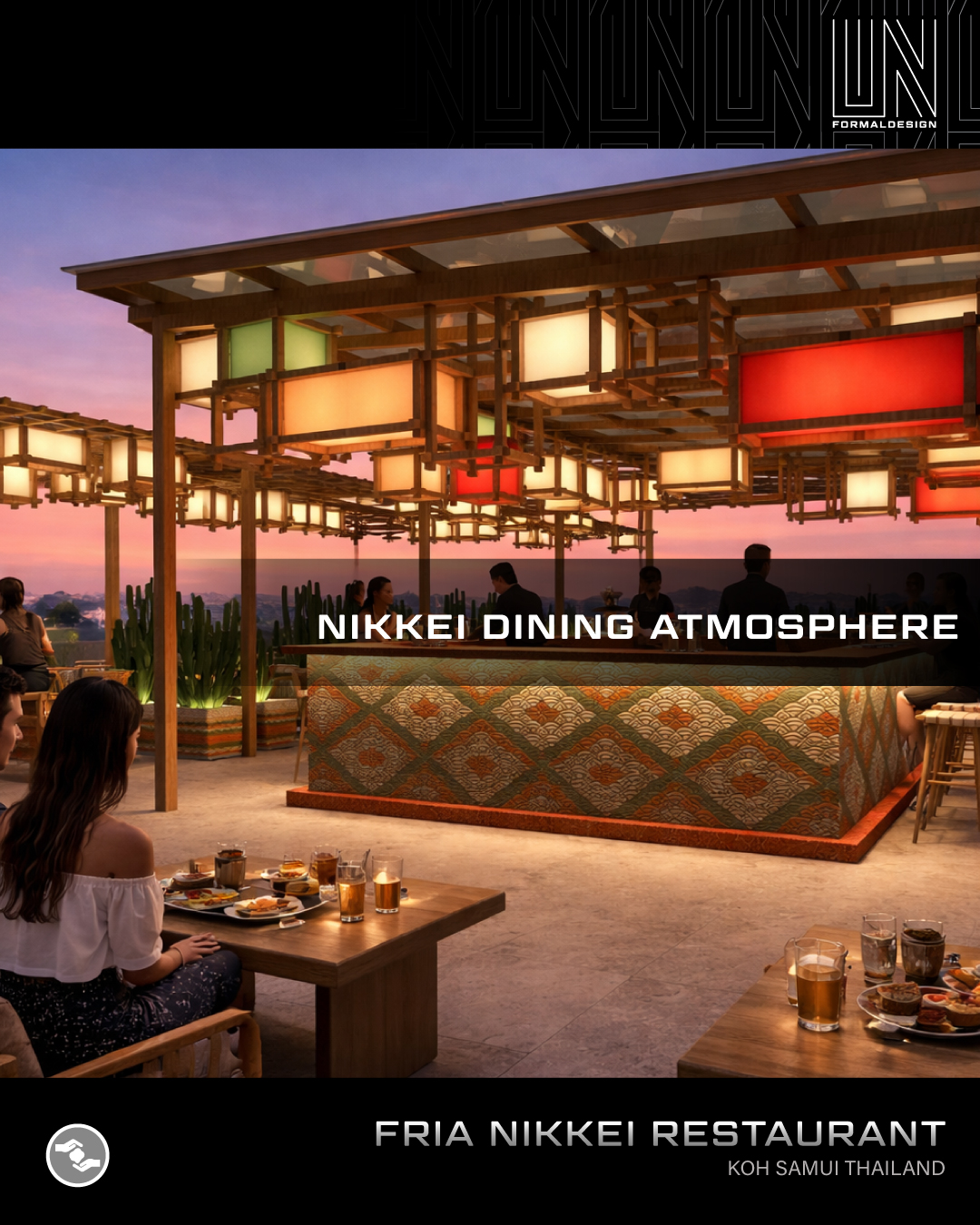
Fria Nikkei in Koh Samui is less of a restaurant and more of an exercise in diplomacy between cultures, colours, and light. We began by listening to the chef’s story of Japanese precision meeting Peruvian rhythm, and then looked at the island itself: the way afternoon sun hits the palms, the calm laps in the bay, the silent warmth of later night. The space needed to feel like a ritual without being theatrical, like a calm choreography for long dinners, sharing plates, and soft theatricality.
The owners wanted the interior to feel like a ritual but not a set piece. We delivered a palette that echoed water, flame, and surf so each surface carries a sense of place. Each texture and light story is layered so the room can change tone from lunch to peak dinner without losing focus.
About UNFORMALDESIGN: https://unformaldesign.com/about/ | Material System: https://unformaldesign.com/material-system/
Internal link placements: restaurant and hospitality projects → https://unformaldesign.com/projects/ | material experimentation → https://unformaldesign.com/material-system/ | design studio in Thailand → https://unformaldesign.com/about/
For us, Fria Nikkei is a restaurant interior design Koh Samui story built around layered hospitality atmosphere rather than visual noise. The goal is not only a beautiful dining room, but an experiential dining design that uses restaurant lighting design, textured finishes, and cultural references to shape a calm but memorable service environment.
Layered collage of light and culture
We treated Fria Nikkei as a collage. Colourful patterns and hand-painted artwork reference the Nikkei currents; lantern-style lighting and handcrafted ceiling installations nod to the island’s craft traditions. The walls are not neutral—they are canvases that hold stories. Each pattern has a rhythm, a brushstroke, a texture that moves from wall to ceiling, echoing the food’s fusion without copying it. The gradients in upholstery follow temperature shifts—cooler in midday heat, warmer as night falls.
Layering moves we orchestrate:
– Colour shifts that respond to the afternoon sun and the island breeze.
– Lanterns suspended at varying heights so the ceiling becomes a constellation.
– Artwork that flows across plaster and timber, creating a continuous narrative.
– Upholstery gradients that allow the furniture to breathe with the palms.
– Curated shelving and display walls that act as both story props and service storage.
Texture as connective tissue
Texture is the connective tissue. We layered plaster with organic ridges, inserts of woven materials, and brassy accents that echo salt, copper, and spice. Ceilings and walls are finished so they acquire patina over time—gloss to matte transitions feel purposeful. The surfaces age gracefully so the more guests touch them, the more they retain the story.
Texture moves we choreograph:
– Hand-painted murals that bleed into plaster grooves, creating resistances of light.
– Brassy accents that pick up neon reflections without overtaking the palette.
– Ceiling installations with layered panels that diffuse light and soften reflections.
– Service zones tucked into the periphery, expressive yet unobtrusive.
– Circulation plotted for lunch, high tide dinners, and slow hours so the vibe stays calm even when the night is loud.
Material experiments and hospitality rituals
UNFORMALDESIGN’s role was to hold the tension between ritual and spontaneity. The experiments we document at https://unformaldesign.com/material-system/ gave us the confidence to let surfaces age intentionally, layer patina into flooring, and treat lighting as a living system rather than a fixture. That material knowledge keeps the craft consistent and shareable with every new crew that steps on site.
How the room changes through the day
One of the most important parts of the Fria Nikkei atmosphere is that it does not stay still. Lunch wants a lighter, more breathable version of the room. Early dinner wants softness and anticipation. Late dinner needs depth, glow, and enough contrast to make each table feel like its own micro-stage. We plan those transitions in advance through light levels, reflectivity, seating balance, and the position of focal surfaces. The design is layered, but the experience remains calm.
That matters for operators because flexibility is part of profitability. A restaurant that can only feel right at one moment of the day leaves value on the table. A restaurant that holds together from bright daylight to a slower, more intimate evening becomes far more resilient. Fria Nikkei shows how atmosphere can be tuned rather than frozen—how theatricality can sit inside an operationally intelligent room.
The result is a Nikkei experience rooted in Koh Samui yet open to the world. Guests can stay for long dinners, share plates that demand conversation, and feel the room gently transform without losing focus. If you want a layered, tactile, alive dining destination, let’s plan the next chapter together. WhatsApp: https://wa.me/66971123561 | Email: mailto:alessio@unformaldesign.com