



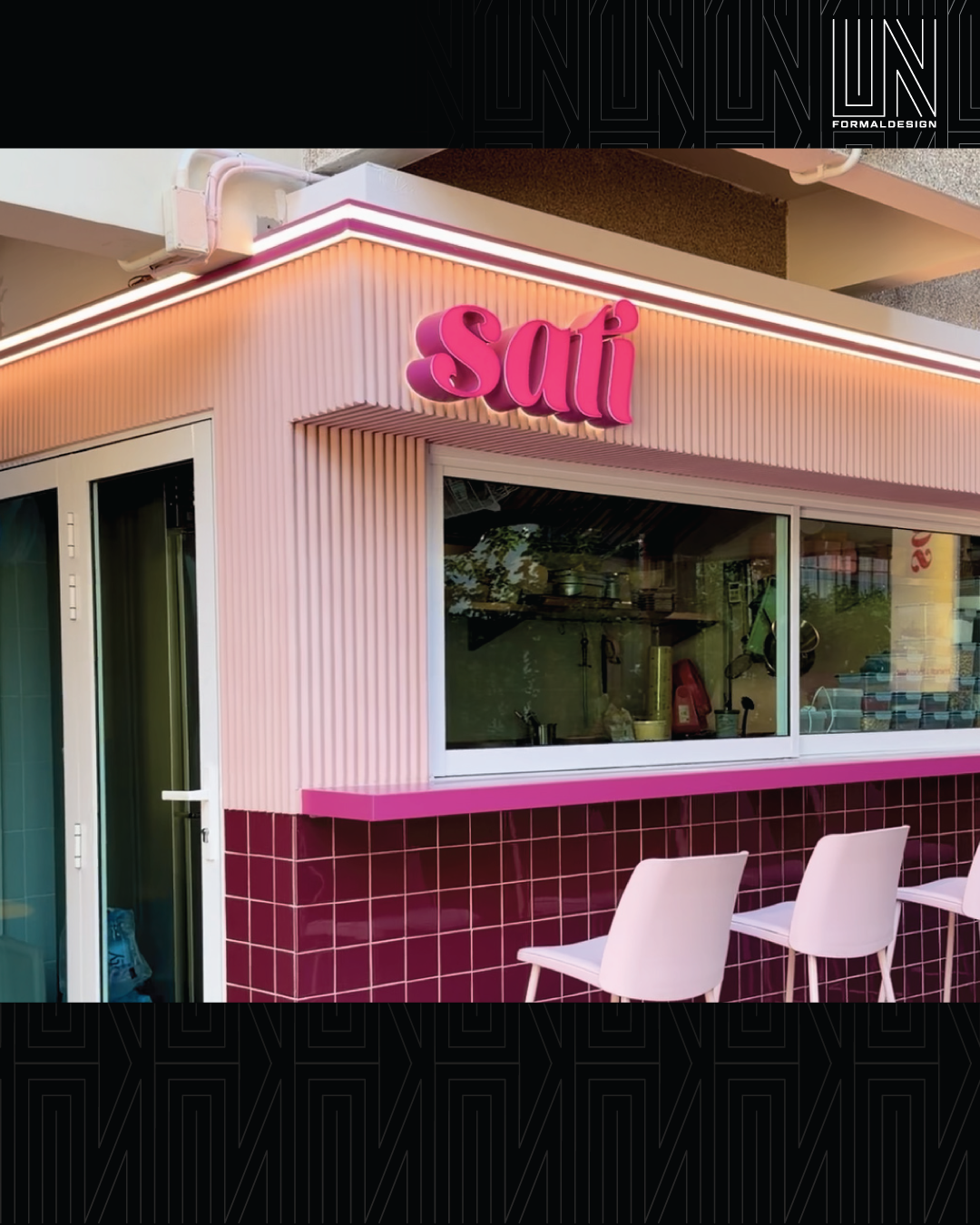
Small hospitality spaces are unforgiving.
There is nowhere to hide a weak idea. If the concept is flat, the whole room feels flat. If the atmosphere is vague, the size makes that vagueness obvious even faster.
SATI works because it does not try to escape its footprint. It uses the smallness as pressure, then turns that pressure into intensity.
UNFORMALDESIGN approached the project as hospitality interior design built through contrast, rhythm, and perception rather than dramatic architecture. The space stays relatively simple in form, but the experience keeps shifting because light is treated like a real material.
About UNFORMALDESIGN: https://unformaldesign.com/about/ | Projects: https://unformaldesign.com/projects/ | Studio Journal: https://unformaldesign.com/studio-journal/
Soft and deeper pink tones create a dual reading of the room. Some areas feel fresh and almost calm, while others gather more saturation and energy. Glossy tiles and glass blocks help that transition by reflecting, diffusing, and softly radiating light instead of just receiving it.
Why the project feels bigger than it is
The answer is not “openness.” It is sequencing.
SATI moves from a quieter street-side reading into more focused and saturated moments deeper inside. That shift gives the room depth even when the physical dimensions stay compact.
A few things make that possible:
\- colour is used as atmosphere, not branding wallpaper;
\- reflective materials multiply perception without turning the room into a mirror trick;
\- compression is treated as an experience, not as a problem to disguise.
That is how a modest footprint starts feeling intentional rather than limited.
What the design is really doing
- It uses light to animate surfaces rather than merely illuminate them.
- It lets simple materials behave theatrically through precision and placement.
- It controls where the room feels quiet and where it feels charged.
- It proves that “experiential” does not require a giant budget or a giant shell.
In small space design, restraint matters. Too many moves would have made the room feel nervous. SATI works because each move has a clear job.
What operators can learn from it
If your venue is small, you do not need more clutter. You need stronger decisions.
Ask:
\- where should the first emotional shift happen?
\- what surface can carry the light hardest?
\- which colour should calm the room, and which one should intensify it?
\- how can the deeper part of the space feel like a destination rather than leftover area?
Those choices matter more than trying to fake spaciousness.
Working with UNFORMALDESIGN
If you’re planning a hospitality or lifestyle venue in Thailand and want a small space to feel layered, sharp, and memorable, message us.
\- WhatsApp: +66 97 112 3561 — https://wa.me/66971123561
\- Email: alessio@unformaldesign.com
Send the venue type, approximate size, and what feeling you want guests to get in the first 10 seconds.