


A thatched roof is a roof covered with dried plant material, such as grass, palm or leaves, laid in thick layers so that rain runs off the surface instead of soaking through. In a resort or beach club it is also a decision about mood: few materials say “tropical, relaxed, close to nature” as fast. UNFORMALDESIGN is a Bangkok-based interior design and architecture studio, led by Italian architect Alessio Carta, that designs hotels, restaurants, bars and beach clubs across Thailand. Every project starts from its Material System, four material families (recycled, natural, industrial and artisan), and thatch belongs to the natural family together with rattan and hemp rope. This article compares natural and synthetic thatch for hospitality projects in Thailand: what each is made of, how long it lasts, what roof pitch it needs and what the fire claims really say.
What materials are used for thatched roofs in Thailand?
Thai thatched roofs use four families of plant material: grass, palm, fan palm and leaf, with grass the most common, according to a 2021 University of Tsukuba study of thatch in Thai architecture. Grass thatch is usually cogon, also called alang-alang (Imperata cylindrica); palm thatch is usually nipa.
The same study surveyed hotels and found thatch on 3.21% of them nationally, rising to 8.62% in Chiang Mai and 3.71% in Phuket, where palm thatch dominates, against just 2 out of more than 2,500 hotels in Bangkok. Thatch is a resort and island material, not a city one.
| Type | Typical plant | Where it shows up | Notes |
|---|---|---|---|
| Grass | Cogon or alang-alang | Resorts, salas, beach bars | The most common Thai thatch |
| Palm | Nipa palm | Coastal resorts, Phuket | Considered the most durable palm thatch |
| Fan palm | Fan palm leaves | Rural and resort roofs | Large leaves, fewer layers |
| Leaf | Dipterocarpus tuberculatus (ton tong teung) | Huts and village gates, notably in Mae Hong Son | A northern, highland tradition |
How long does natural thatch last in the tropics?
Natural palm or grass thatch typically lasts about 5 to 8 years in a tropical climate, according to a review published by the International Coconut Community, with nipa as the most durable palm. Heat, humidity, rain and insects all shorten its life compared with thatch in cooler countries.
Older field data is even more cautious: a building guide reprinted in 1969 recorded grass thatch in Malaya lasting about 2 years and palm thatch about 3, rising to 6 on a very steep roof. Synthetic thatch suppliers quote full replacement of natural thatch every 5 to 7 years in the tropics; that figure comes from a vendor, so it should be read as a sales argument that happens to agree with the independent sources.
Roof pitch matters as much as material. Natural thatch needs a pitch of at least 45 degrees, and 50 to 55 degrees is preferred, according to guidance from the East Anglian Master Thatchers Association. A steep roof sheds water before it can soak in, which is why the classic thatched sala has its tall, pointed silhouette. For a designer, that is a form decision as much as a technical one: choosing natural thatch means choosing a steep roof.
What is synthetic thatch, and what do the fire ratings mean?
Synthetic thatch is a roof covering made of PVC or HDPE plastic, moulded and coloured to look like grass, palm or reed. It is sold with 20 year warranties and fire ratings, and it works on much flatter roofs than natural thatch.
One leading manufacturer, Endureed, publishes the numbers on its data sheets. Its Bali profile (PVC) claims an ASTM E108 Class A fire rating and an ASTM E84 flame spread index of 12.5, accepts a minimum pitch of 3:12 (14 degrees) and weighs 14 to 24 kg per square metre as a system. Its Performance Palm profile (HDPE) claims ASTM E108 Class A and a minimum pitch of 4:12 (18 degrees), with a 20 year warranty.
Two cautions belong in every specification. First, these are manufacturer claims based on the manufacturer’s tests, not independent certification for a Thai project. Second, the same data sheet describes a separate Class A build-up with gypsum board underneath, so the project team should confirm whether the Class A rating applies to the plain thatch or only to that full assembly. The Bali data sheet also quotes both a 20 year and a 30 year warranty on different pages.
| Natural thatch | Synthetic thatch | |
|---|---|---|
| Material | Grass, palm or leaf | PVC or HDPE plastic |
| Lifespan in the tropics | About 5 to 8 years | 20 year warranties quoted by manufacturers |
| Minimum roof pitch | 45 degrees, ideally 50 to 55 | 14 to 18 degrees, depending on product |
| Fire | Combustible | Class A claimed under ASTM E108, check the assembly |
| Look and smell | Real texture, ages and fades | Consistent colour, no natural smell |
| Maintenance | Regular repair and full replacement | Low, mainly cleaning |
Is a thatched roof a fire risk?
Natural thatch burns, and in a hospitality setting the ignition sources are close by: grills, fire pits, candles and fireworks. In Mae Phim, Rayong, over New Year 2012 to 2013, a misfired rocket set fire to a thatched restaurant roof and the fire spread to more than 10 shops, with damage of about 10 million baht, as reported at the time.
Thai rules focus on the structure rather than the roof covering. Under the Building Control Act, Ministerial Regulations 48 (B.E. 2540) and 55 (B.E. 2543) require the columns, beams and floors of hotels to be fire resistant; an English compilation of those rules from 2003 does not list the roof covering. Regulations have been amended since, so the current text and any local by-laws must be checked with the project architect and the local authority before thatch goes over a bar or a kitchen.
The practical design rule follows from both points: keep natural thatch away from open flame and cooking, and consider synthetic thatch, or a different roof, over grills, fire pits and bars.
How does UNFORMALDESIGN use thatch in hospitality projects?
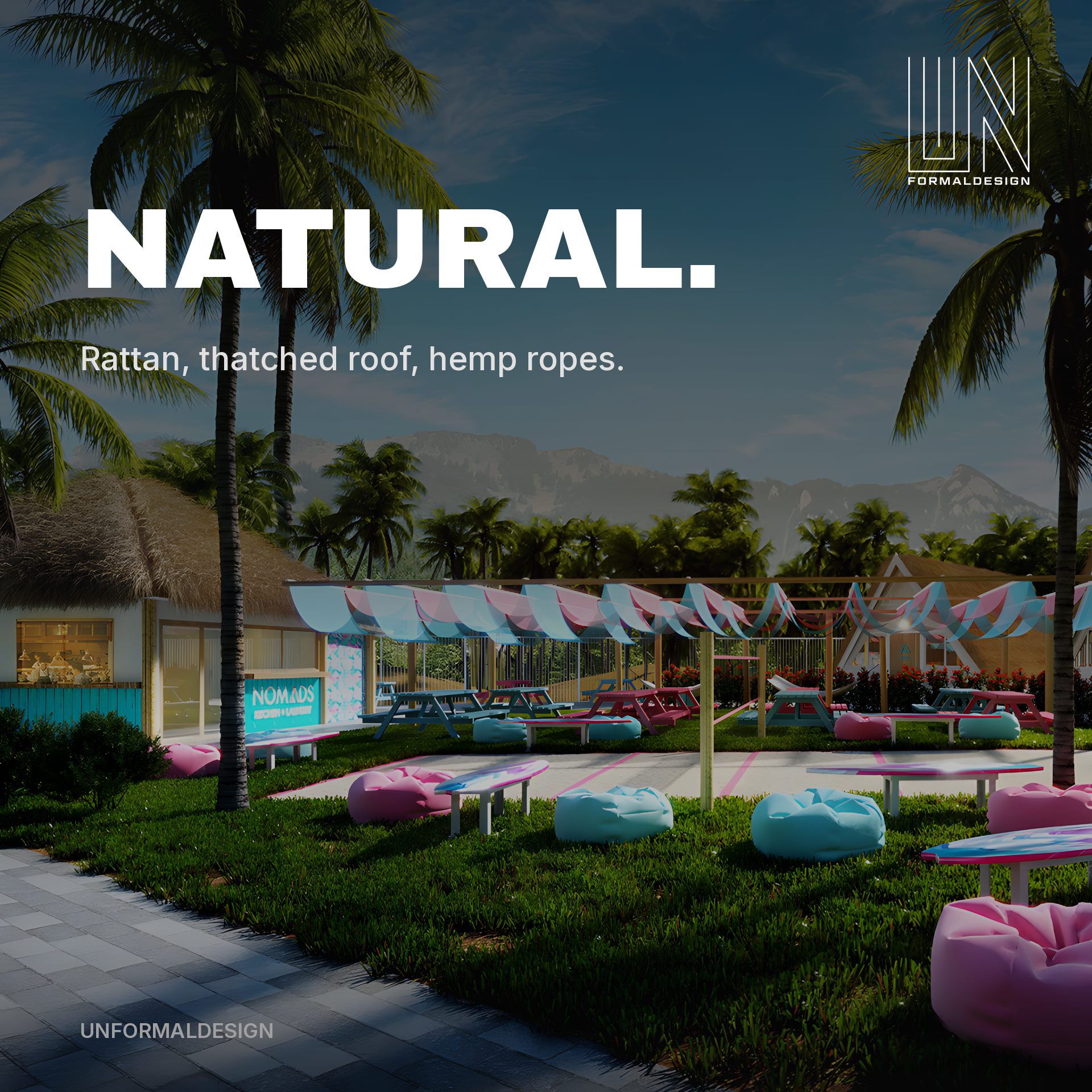
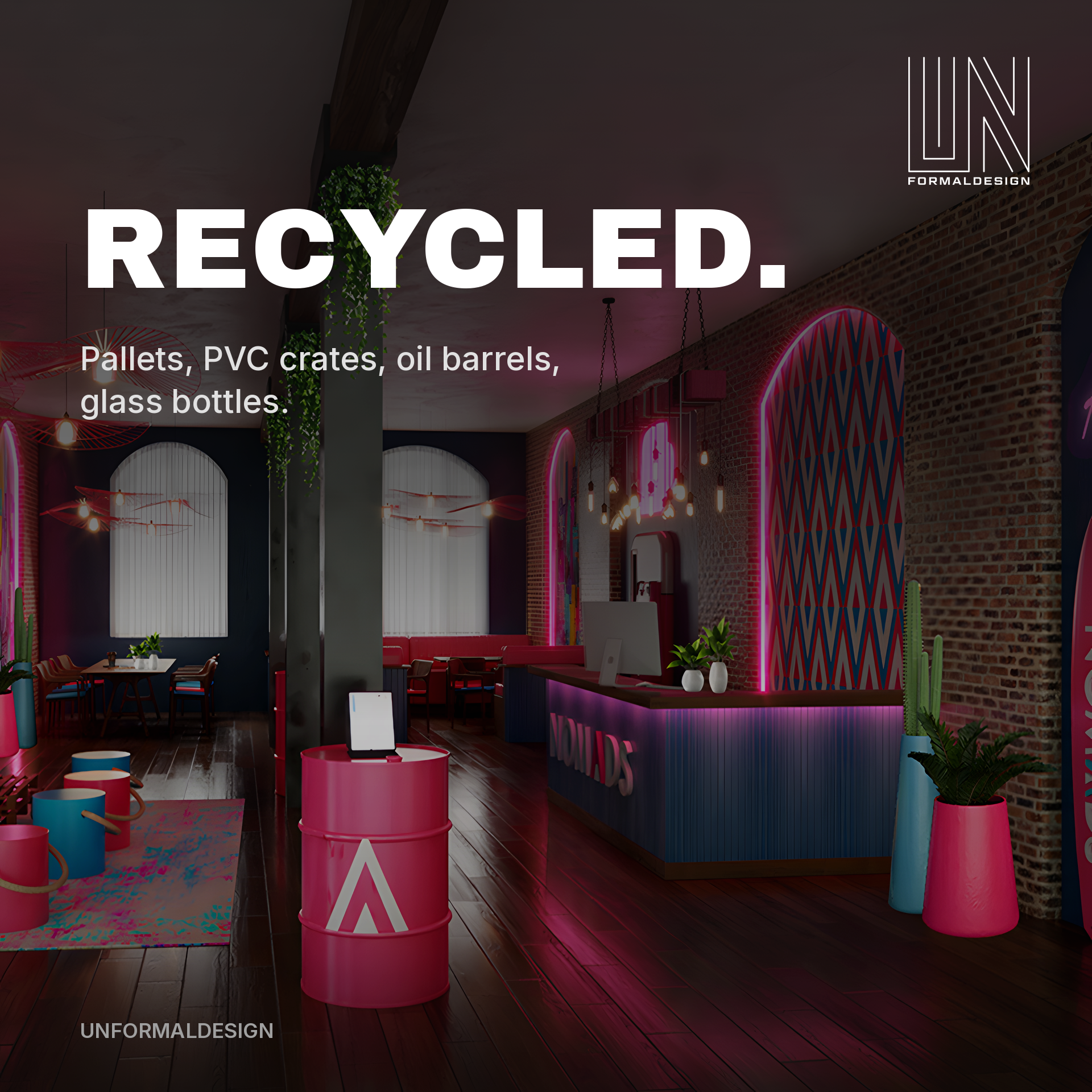
UNFORMALDESIGN uses thatch as part of the natural family of its Material System, chosen first and allowed to set the mood, rather than added as decoration at the end. At NOMADS Beach on Magnetic Island, Australia, the studio combined rattan, thatch and hemp ropes with recycled cable-reel and surfboard furniture to make a coastal hostel feel relaxed and rooted in its place. At El Dangeroso, a Mexican-themed nightlife venue, thatch and palm-leaf screens warm a room otherwise built on neon, walnut and leather.
The same thinking applies to beach clubs on Koh Samui, where the studio designed Socialtel, a 10,000 square metre site whose materials were chosen to read one way under the sun and another after dark. Thatch works there only if it survives the daily cycle of salt air, rain and heat, which is why maintenance belongs in the design brief, not in the opening checklist. In Bangkok restaurants and bars, where thatched roofs are almost absent, thatch works better indoors as a ceiling or screen element than as a roof.
Frequently Asked Questions
How long does a thatched roof last in Thailand? Natural grass or palm thatch usually lasts about 5 to 8 years in a tropical climate like Thailand’s, and less on low-pitched roofs or in very wet locations. Nipa palm is considered the most durable palm thatch. Synthetic thatch made of PVC or HDPE is sold with 20 year warranties, which manufacturers back with their own tests.
Is synthetic thatch fireproof? No roof covering is fireproof, but several synthetic thatch products claim an ASTM E108 Class A fire rating, the highest class in that roof covering test. These are manufacturer test claims. Check whether the rating applies to the thatch alone or to a full assembly with fire-rated board underneath, and confirm Thai requirements with the project architect.
What roof pitch does a thatched roof need? Natural thatch needs a pitch of at least 45 degrees, and 50 to 55 degrees is preferred so rain runs off before it soaks in. Synthetic thatch works on much flatter roofs: published minimums range from about 14 to 18 degrees depending on the product. The pitch therefore decides the shape of the building as much as the material does.
Should a beach club use natural or synthetic thatch? Natural thatch gives the most authentic texture but needs steep roofs, regular repair and full replacement every few years, and it burns. Synthetic thatch needs less maintenance, works on flatter roofs and claims high fire ratings. A practical split is synthetic thatch over bars, kitchens and fire pits, and natural materials where guests touch and see them up close.
Does UNFORMALDESIGN design resorts and beach clubs in Thailand? Yes. UNFORMALDESIGN is a Bangkok-based interior design and architecture studio led by Italian architect Alessio Carta. It designs hotels, beach clubs, restaurants and bars across Thailand, including Socialtel on Koh Samui, using a Material System of recycled, natural, industrial and artisan materials. Contact alessio@unformaldesign.com or WhatsApp +66 97 112 3561.
The takeaway
A thatched roof is a mood decision with technical consequences. Natural thatch gives real texture but lasts about 5 to 8 years in the tropics, needs a 45 degree pitch and burns; synthetic thatch lasts longer and fits flatter roofs, but its fire and warranty claims need checking against the actual assembly. Choosing the material first, as UNFORMALDESIGN’s Material System does, means the roof, the budget and the maintenance plan follow from that choice instead of fighting it.
Internal links: /material-system/ (UNFORMALDESIGN Material System) · /interior-design-koh-samui/ (interior design on Koh Samui) · /beach-club-design-koh-samui-socialtel-day-night/ (Socialtel beach club, Koh Samui) · /projectes/nomads-beach-2/ (NOMADS Beach) · /coastal-interior-design-maintenance-thailand/ (maintenance in coastal interiors) · /restaurant-interior-design-bangkok/ (restaurant interior design in Bangkok)