


Industrial dining rooms often get one thing very wrong.
They keep the roughness but lose the hospitality.
Concrete, brick, exposed services, and metal mesh can create energy, yes, but without warmth and curation the room quickly feels more like a shell than a place people want to sit in for long.
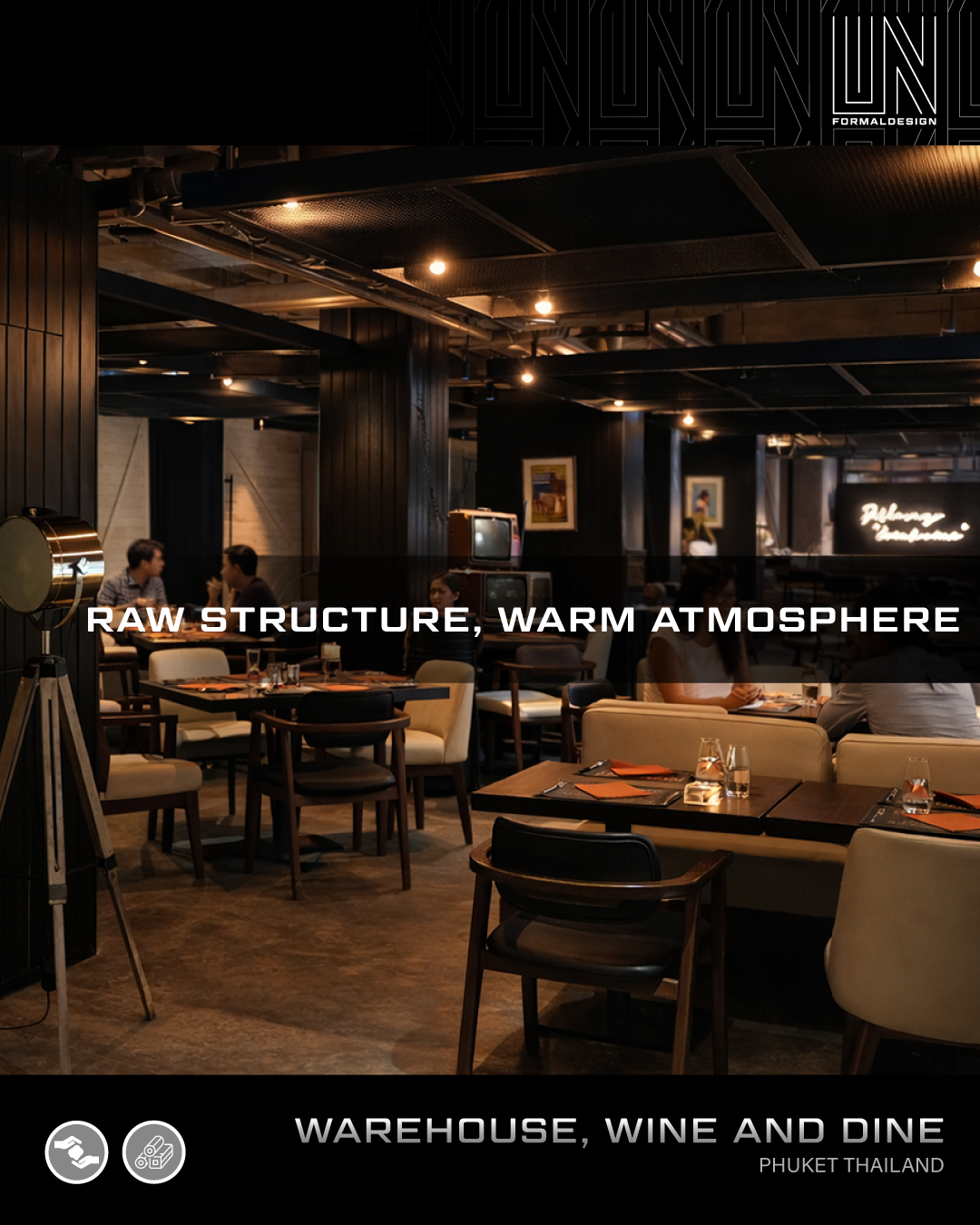
This project works because hotel restaurant interior design like this cannot rely on rawness alone. The industrial language is only the base layer. On top of that, UNFORMALDESIGN adds social logic, artwork, neon, vintage objects, and warmer material moments so the room feels structured but not cold.
About UNFORMALDESIGN: https://unformaldesign.com/about/ | Projects: https://unformaldesign.com/projects/ | Studio Journal: https://unformaldesign.com/studio-journal/
The reference to early New York factories is clear, but the room is not trying to become a movie set. It uses exposed concrete, brick, and steel mesh as the backbone, then balances them with curated details that make the experience more human.
That is why the dining environment feels social rather than severe.
What makes it work
The space does not rely on one statement move. Its strength is in the tension between rawness and editing.
A few things are doing the heavy lifting:
\- industrial structure gives the room clarity and scale;
\- artworks and neon introduce identity and visual warmth;
\- vintage objects soften the reading and stop the room from feeling too engineered;
\- the layout supports a social core instead of scattering energy across the whole floor.
That combination matters because all day dining design has to carry more than one mood. Morning, lunch, casual meetings, and later social dining all ask slightly different things from the same room.
Why “industrial but warm” is harder than it sounds
A lot of projects say that sentence. Fewer actually achieve it.
To make the balance believable, the room needs:
- rough structure that feels honest, not lazy;
- warm light that softens the hard surfaces without flattening them;
- enough texture and graphic punctuation to create memory;
- seating and circulation that let guests feel social without feeling exposed.
If those parts do not line up, the industrial layer wins and the room becomes tiring fast.
What operators can learn
If you want a social dining environment with industrial energy, ask:
\- where is the social core of the room?
\- what warms the concrete and brick emotionally?
\- what keeps the room recognisable beyond the raw shell?
\- how will the space read differently from breakfast to late evening?
Those questions decide whether the concept feels atmospheric or just visually tough.
Working with UNFORMALDESIGN
If you’re planning an all-day dining, hospitality, or restaurant concept in Thailand and want industrial materiality without losing comfort, message us.
\- WhatsApp: +66 97 112 3561 — https://wa.me/66971123561
\- Email: alessio@unformaldesign.com
Send the venue type, city, and whether you want the atmosphere to lean more raw, more social, or more curated.