


Wood is one of the easiest materials to make boring.
Used lazily, it turns into generic slats, decorative screening, or safe warm surfaces that disappear into the background. Used with more discipline, it can become a spatial field.
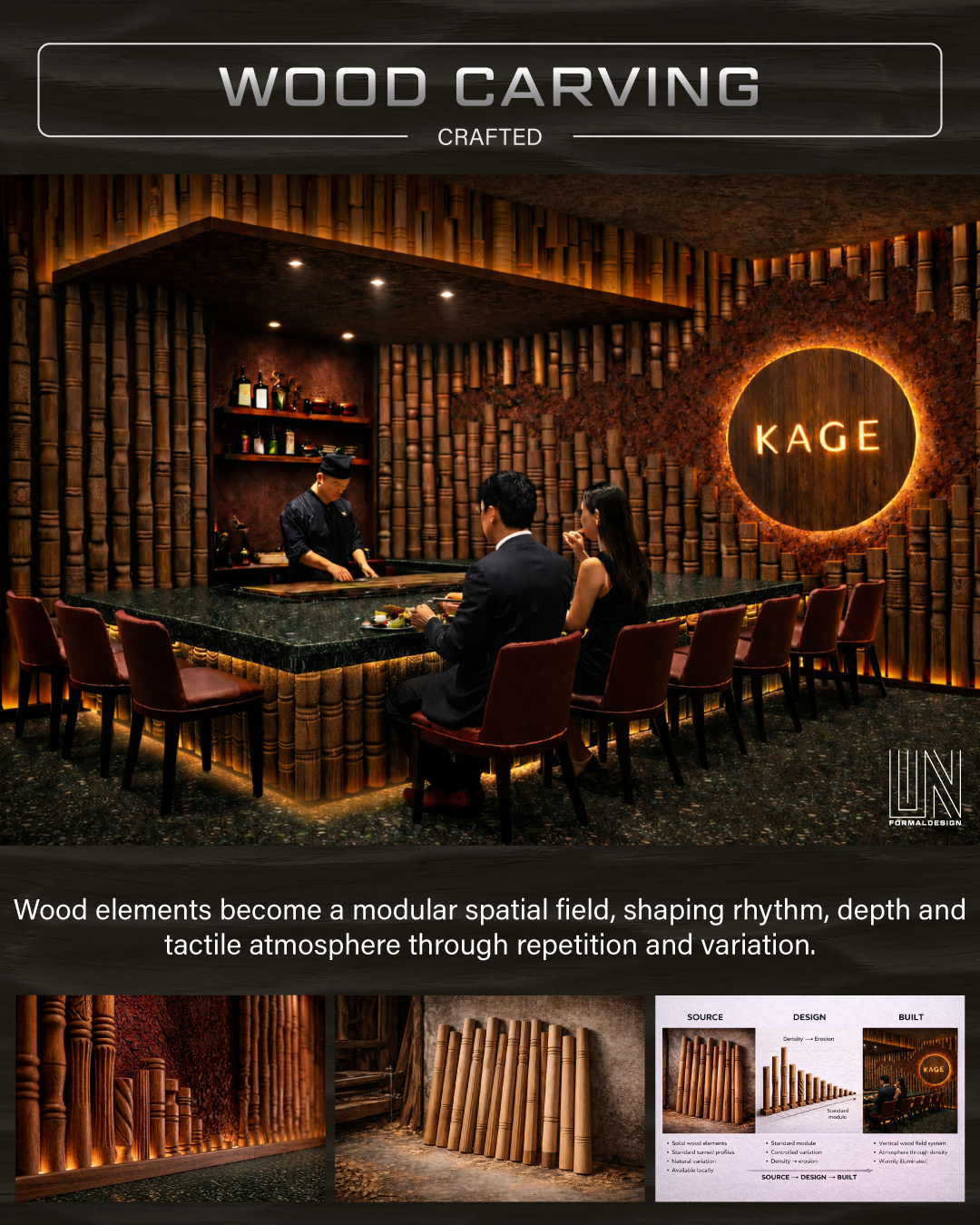
That is the logic here. Simple wood elements are repeated vertically, then adjusted through height, spacing, and density so the system moves from more solid to more open.
In hospitality interior design, UNFORMALDESIGN treats the result less like a wall finish and more like a filter. The field shapes depth, rhythm, and permeability while grazing light brings out texture and shadow.
About UNFORMALDESIGN: https://unformaldesign.com/about/ | Material System: https://unformaldesign.com/material-system/ | Projects: https://unformaldesign.com/projects/
The effect is low-tech, but it does not feel simplistic. That is because repetition is doing real work.
Why the system works
The strongest thing about the vertical wood field is that it makes atmosphere through a very ordinary material.
What creates the richness is not ornament. It is the relationship between elements:
\- tighter spacing creates density and privacy;
\- wider spacing introduces openness and rhythm;
\- changes in height keep the field from feeling static;
\- base-grazing light pulls texture and shadow upward.
That combination gives the system a tactile quality even before anyone touches it.
Where it can work well
A modular wood field can be useful as:
- a hospitality backdrop that needs warmth without flatness;
- a low-tech partition between social zones;
- a feature wall where shadow should feel soft and crafted;
- a screen that filters views rather than closing them completely.
It is especially useful where the project wants atmosphere through material logic instead of big formal moves.
What to be careful about
Wood repetition only feels elegant when the rules are tight.
Things that matter:
\- keeping the spacing transitions intentional;
\- controlling how the base meets the floor;
\- avoiding awkward top terminations;
\- choosing a wood tone that behaves well under the venue’s lighting scenes.
Otherwise the whole system can start looking like standard joinery instead of something spatial.
Thailand reality check
Humidity, cleaning, and daily use all affect wood. The system has to be designed with that in mind. Some parts may carry atmosphere; other parts need to carry abuse.
That is the balance worth getting right. Warmth is easy. Warmth that survives service is harder.
Working with UNFORMALDESIGN
If you’re planning a hospitality, restaurant, lounge, or lifestyle venue in Thailand and want a wood system that feels atmospheric rather than generic, message us.
\- WhatsApp: +66 97 112 3561 — https://wa.me/66971123561
\- Email: alessio@unformaldesign.com
Send the venue type, where the field would sit, and whether the space needs more intimacy, more rhythm, or more permeability.