


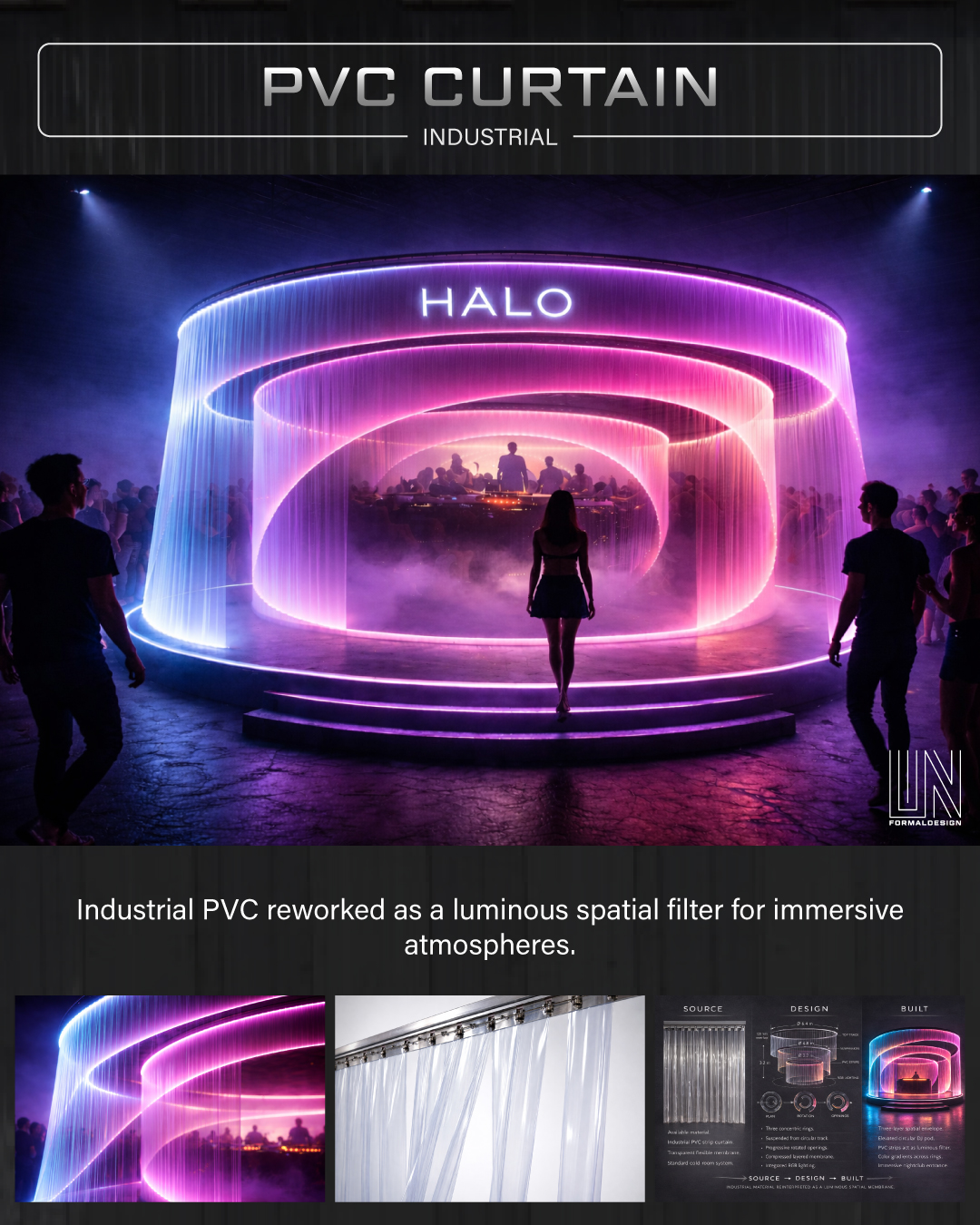
PVC strip curtains usually keep a zone closed—cold air stays in, dust stays out, floors stay separated. In recycled materials interior design, we treat the same strips as a performative membrane that filters light, movement, and perception without ever building a solid wall.
UNFORMALDESIGN views this system through the hospitality interior design lens: softness and rhythm instead of barriers. The membrane becomes a spatial signal for the room, letting people see, sense, and move through layers of atmosphere instead of bumping into a hard edge.
About UNFORMALDESIGN: https://unformaldesign.com/about/ | Material System: https://unformaldesign.com/material-system/ | Projects: https://unformaldesign.com/projects/
Why the membrane matters in hospitality
It does three moves at once:
\- it defines a zone without cutting it off, so guests still feel the energy on the other side;
\- it catches, diffuses, and sometimes colour-washes light, which turns it into a layered lantern rather than a curtain;
\- it introduces gentle movement as people pass through, turning the partition into a living tension rather than a dead wall.
That tension is the point. When you overlap panels, visibility morphs, reflections shift, and silhouettes appear and vanish. The membrane is not meant to be static—it is a choreography partner for the wider atmosphere.
How we treat the system
- Frame the strips as thresholds: drape them at entrances, bar edges, or lounge wraps so the arrival feels staged rather than abrupt.
- Control the density so it never reads accidental or cemented. Calibrate overlap, colour, and transparency until the membrane still reads as a field.
- Light the membrane, not just the room. Concealed glow, pixel washes, or programmable colour shift turn the PVC into a feature instead of storage.
- Refine human touchpoints. Where hands meet the material, the edges, fixings, and cleaning logic must feel deliberate—not “cheap curtain.”
The best experiments keep the installation simple so maintenance stays manageable, while the screening still sings.
Thailand reality check
Lightweight systems are appealing in Thailand because they are flexible and fast, but the climate demands testing:
\- check yellowing under heat and humidity;
\- verify suspension logic so the tracks survive heavy use and cleaning;
\- test the material against cool versus warm light so the membrane never reads brittle;
\- inspect how it ages after weeks of contact before promising the atmosphere it will keep.
Case: OMBRA and the art of reveal
OMBRA teaches the same lesson: atmosphere is built by what you let people see partially, not by sealing everything off. Light, shadow, and texture carry the story. A PVC membrane can follow that logic by turning movement and reflection into controlled reveals.
Questions to ask
- Is the membrane dividing, wrapping, or staging arrival?
- What light will wash through it, and how does that change over time?
- How dense should the overlap be so the space feels both intimate and connected?
- Which edges need refinement because hands will touch them every service?
- What happens after six months of daily flow—does it still feel intentional or just temporary?
Working with UNFORMALDESIGN
If you’re planning a bar, club, café, or hospitality venue in Thailand and you want to explore a lightweight material system that feels atmospheric rather than temporary, message us.
\- WhatsApp: +66 97 112 3561 — https://wa.me/66971123561
\- Email: alessio@unformaldesign.com
Send the venue type, approximate area, and where you see the membrane working best.