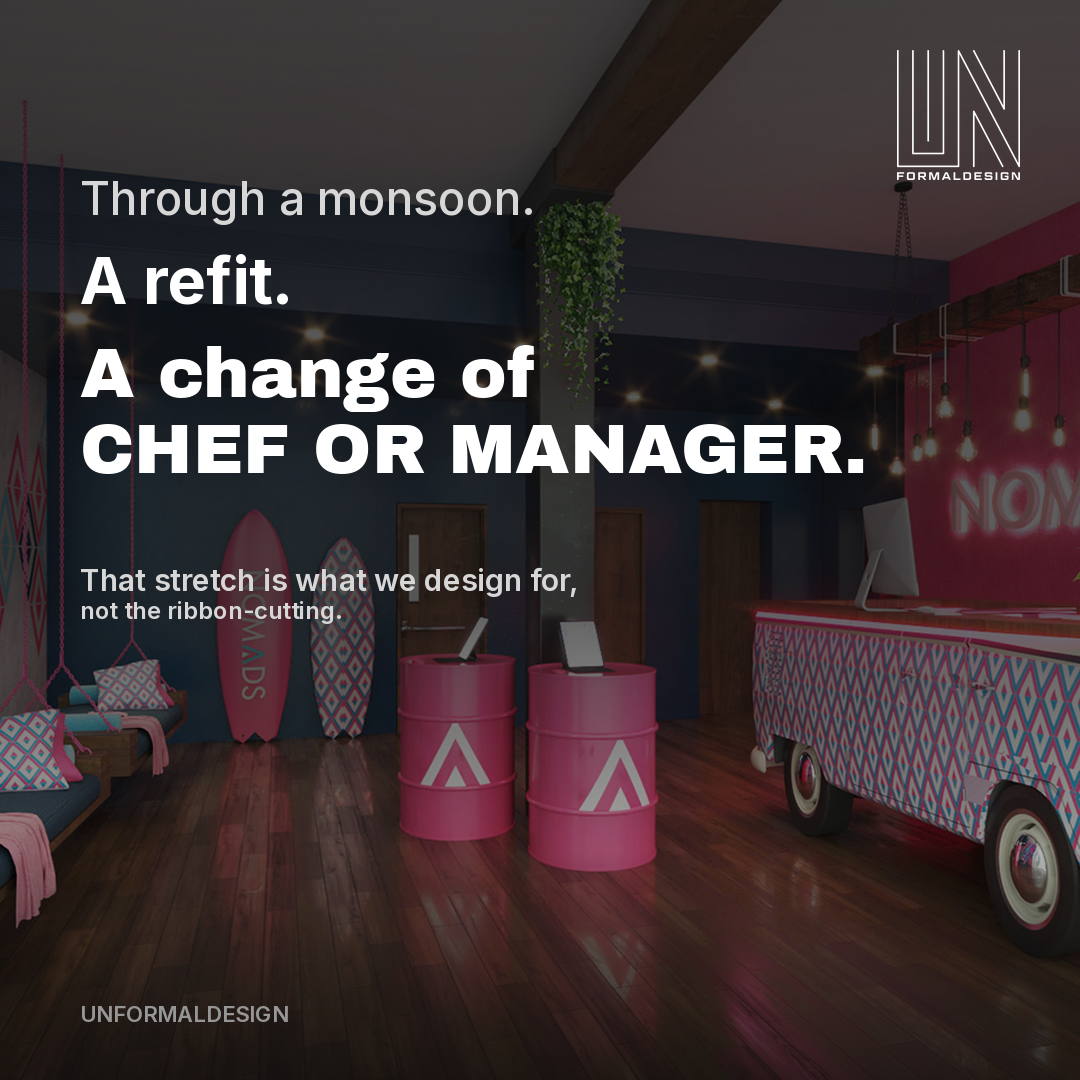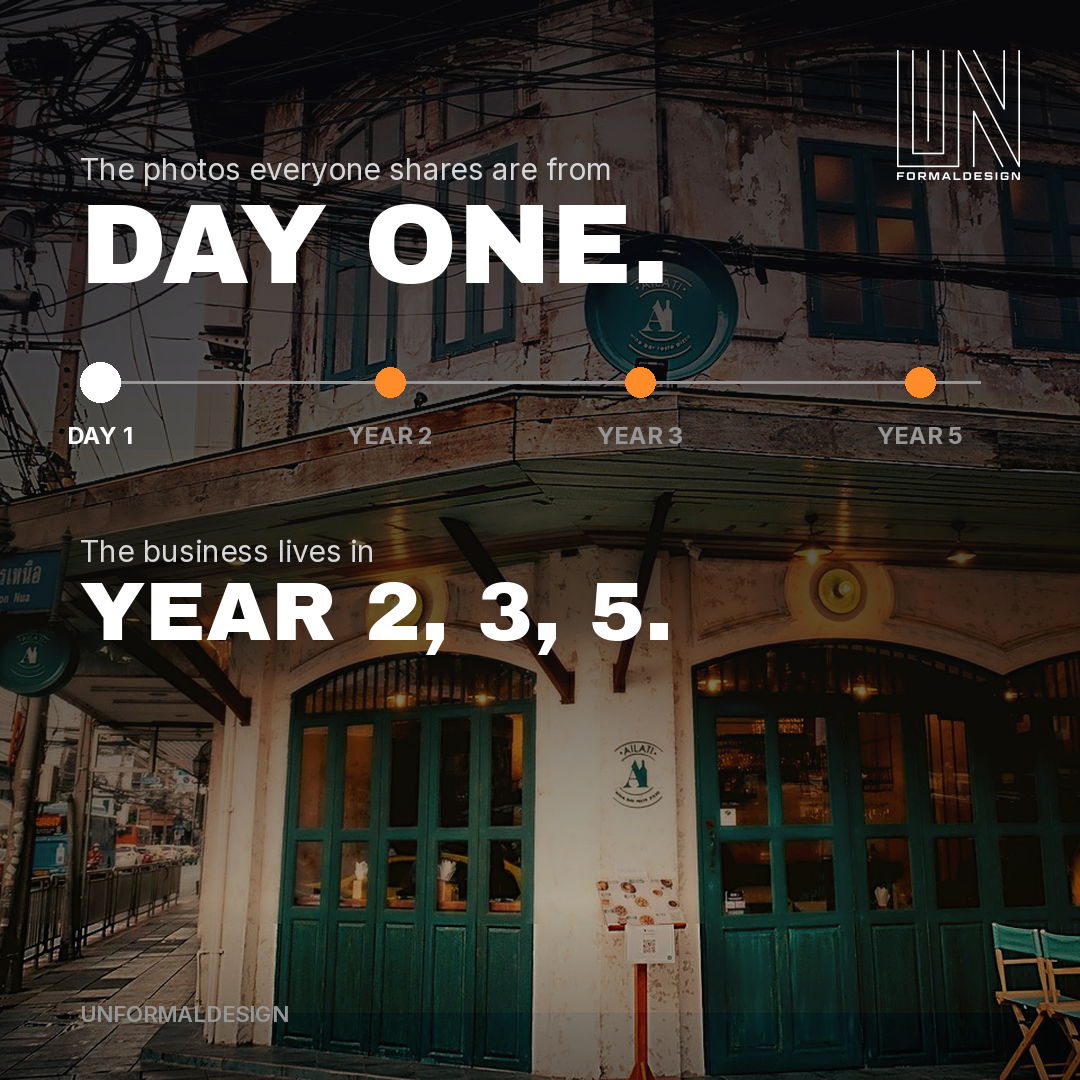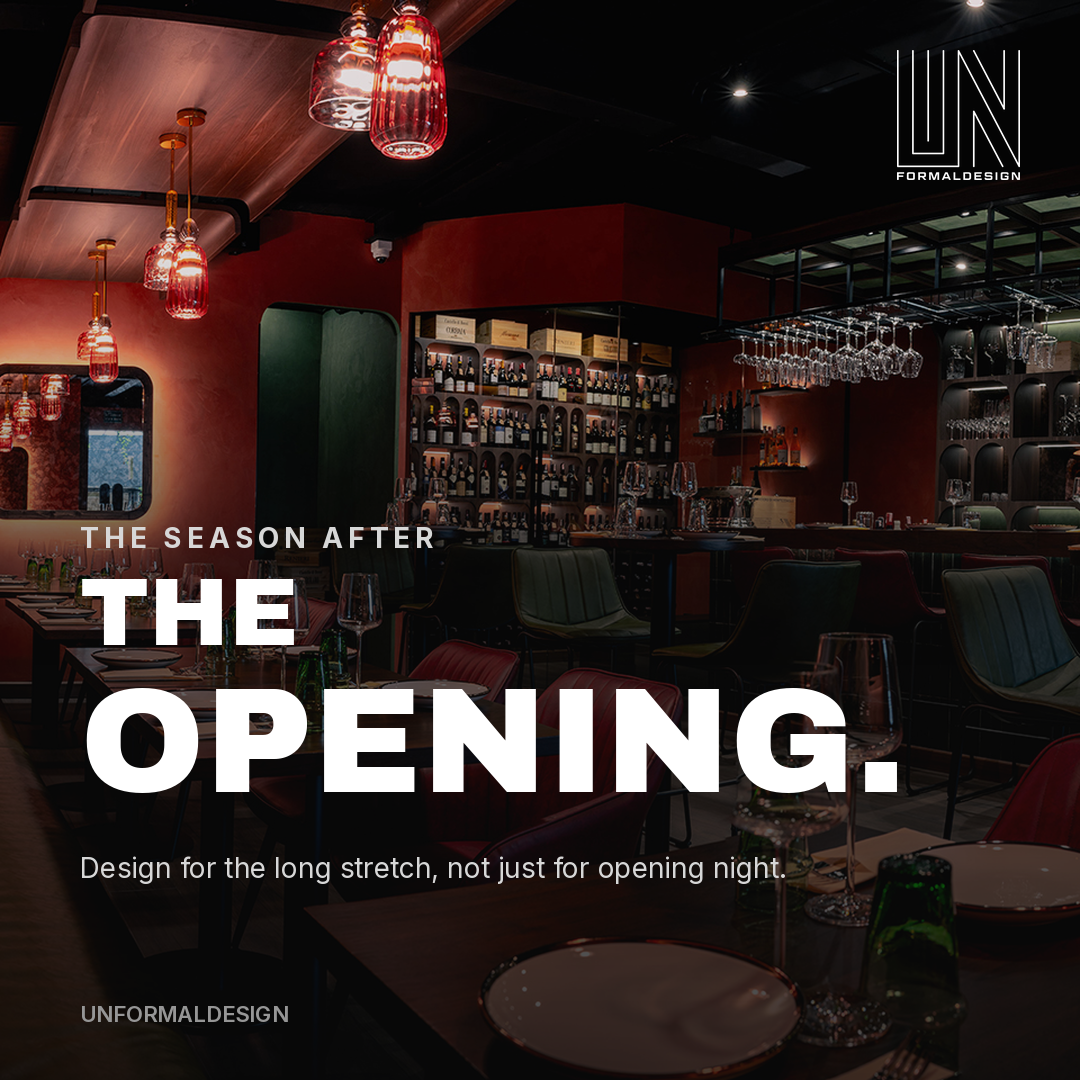



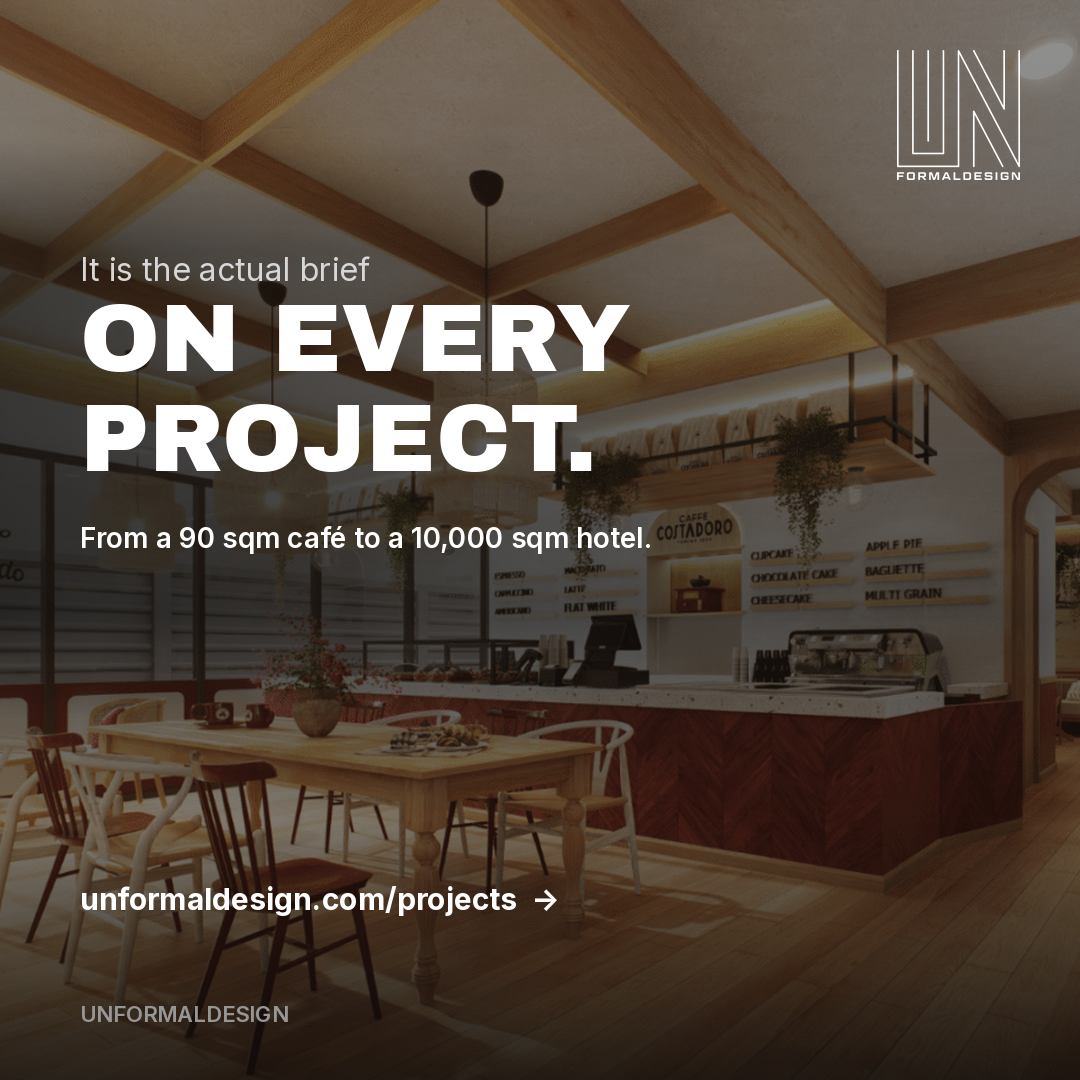
A restaurant or hotel refurbishment is cheapest when it was planned on the first day of the original design. The opening photos show a venue on day one, but the business earns its return in year two, three and five, through daily use, changing seasons, wear and evolving operational needs. UNFORMALDESIGN is a Bangkok-based interior design and architecture studio, led by Italian architect Alessio Carta, that designs hospitality and F&B venues across Thailand, including Koh Samui. Its brief on every project, from a 90 sqm café to a large hospitality project, is the stretch after opening night. This article explains what that brief changes in practice.
What does it mean to design a venue for its refurbishment?
Designing for refurbishment means separating the parts of an interior that wear out fastest from the parts that last longest, so that the fast parts can be replaced without touching the slow ones. A refurbishment-ready interior is one where a new look, a new menu or a new operator costs a refit, not a rebuild.
Most refurbishment budgets are lost in the gaps between those parts. A decorative wall finish that hides the only access to the plumbing, a bar built into the structure, or lighting wired into a single scene: each of these turns a cosmetic update into demolition.
Which parts of a restaurant or hotel last, and which get replaced?
A building changes in layers that age at different speeds. The writer Stewart Brand set this out in How Buildings Learn (1994), building on the architect Frank Duffy’s work: structure lasts 30 to 300 years, the skin about 20, services 7 to 15, and a commercial space plan can change every 3 years. In hospitality, the fastest layers change even sooner.
| Layer | In a restaurant or hotel | Typical life (Brand, 1994) | Day-one design rule |
|---|---|---|---|
| Structure | Columns, slabs, stairs, roof | 30 to 300 years | Never make a bar, booth or kitchen depend on it |
| Skin | Facade, glazing, roof covering | About 20 years | Design shade and rain protection that do not need interior changes |
| Services | Kitchen extraction, drainage, power, air conditioning | 7 to 15 years | Leave access and spare capacity for a different kitchen |
| Space plan | Bar position, seating layout, partitions | Around 3 years in commercial space | Build it from parts that can be moved |
| Stuff | Furniture, lighting scenes, art, textiles | Months to a few years | Treat it as the part that carries each new concept |
The rule that follows is simple: the faster a layer changes, the easier it must be to reach and remove. UNFORMALDESIGN’s material system applies the same logic to finishes, turning pallets, PVC crates and oil barrels into modular units for walls, bars and seating that can be reconfigured instead of demolished.
Three tests every hospitality brief should pass
A hospitality brief is ready when the design survives three ordinary events that are certain to happen within five years. None of them is a crisis. Each is a normal part of running a venue in Thailand, and each is expensive only if day one ignored it.
The monsoon test. Where do guests, furniture and water go when it rains for a week? On Koh Samui the heaviest rain arrives roughly from October to December, according to Thai Meteorological Department climate records, while Bangkok’s wet season runs from about May to October. An island venue therefore needs covered routes, storage for outdoor furniture and drainage sized for its own calendar, not Bangkok’s.
The new chef test. A new chef can change a menu within months, but the kitchen sits on the services layer, which lasts 7 to 15 years. Extraction, gas, drainage points and electrical capacity that fit only one menu will force a rebuild when the concept changes. Access panels and spare capacity cost little at construction and a great deal afterwards.
The new manager test. If the venue only works because of the team that opened it, it will not survive the first change of manager. Service stations, storage and back-of-house routes should explain themselves to someone who was not in the design meetings.
What a refit looks like when the layers are separate: Socialtel, Koh Samui
At Socialtel on Koh Samui, UNFORMALDESIGN worked on an existing building and led the full rebrand and spatial redesign, not only the visual identity. The venue runs as a relaxed beach club and pool retreat by day and a high-energy social destination by night, and lighting, materials, acoustic zoning and circulation were designed to deliver both modes without changing the architecture itself.
That is the refurbishment principle at small scale: the venue changes character every evening through its fast layers, while the structure stays where it is. Other UNFORMALDESIGN work on Koh Samui includes the Fria Nikkei restaurant and the Silque nightclub.
What this article does not cover
There is no fixed refurbishment cycle for a restaurant or hotel. It depends on floor area, how hard the space is used and the climate. Google Ads Keyword Planner data pulled on 28 September 2026 shows about 210 monthly searches worldwide for “hotel refurbishment” and 110 for “restaurant refurbishment”, with almost none specific to Thailand. For island costs and timelines, see interior design on Koh Samui and what interior design costs on Koh Samui.
Working with UNFORMALDESIGN
The most useful brief describes how the venue should work in year five, not just on opening night. For a restaurant, bar or hotel on Koh Samui, in Bangkok or elsewhere in Thailand, contact UNFORMALDESIGN at alessio@unformaldesign.com or on WhatsApp at +66 97 112 3561.
Frequently Asked Questions
What is a restaurant refurbishment? A restaurant refurbishment is the renewal of an operating venue’s interior, usually its finishes, furniture, lighting and sometimes its layout, without rebuilding the structure. The cost depends on how the original design separated the fast-changing parts from the permanent ones. A layered design keeps a refurbishment close to a cosmetic budget.
How often do restaurants and hotels need a refurbishment? There is no fixed interval. Stewart Brand’s research on buildings puts building services at 7 to 15 years and commercial space plans at around 3 years, and hospitality furniture and lighting often change sooner. Use, climate and concept changes decide the timing, so the design should assume a refit well within the lease.
How can a new venue be designed to make future refurbishment cheaper? Keep bars, booths and kitchens independent from the structure, leave access and spare capacity in drainage, extraction and power, and build finishes and partitions from modular parts that can be removed. On day one these choices cost little. After opening, each one decides whether a refit is cosmetic or requires demolition.
When is the best time to refurbish a venue on Koh Samui? Many operators refit during the island’s quieter, wetter months. On Koh Samui the heaviest rain comes roughly from October to December, unlike Bangkok’s May to October wet season, so an island refurbishment timeline should follow the island’s own calendar and leave room for weather delays on site.
Does UNFORMALDESIGN take on refurbishments of existing venues? Yes. UNFORMALDESIGN has redesigned existing hospitality buildings, including the full rebrand and spatial redesign of Socialtel on Koh Samui. The studio handles concept, design development and construction follow-up for restaurants, bars, beach clubs and hotels in Bangkok, on Koh Samui, in Phuket and elsewhere in Thailand.
The takeaway
A restaurant or hotel refurbishment is a decision made twice: once when the venue is designed and again when it is refitted. UNFORMALDESIGN designs hospitality interiors in Thailand so that the second decision is the cheaper one.
Internal links: /interior-design-koh-samui/ (interior design on Koh Samui) · /interior-design-koh-samui-cost/ (Koh Samui cost and timeline) · /material-system/ (the UNFORMALDESIGN material system) · /projects/ (projects)