


Multi-location hospitality interior design is the practice of keeping a brand recognisable across cities while letting each room respond to its own climate, crowd and culture. The identity travels; the room adapts. Copying a successful venue detail-for-detail into a new market is the most common and most expensive way to open a weak second site. UNFORMALDESIGN is a Bangkok-based architecture and interior design studio led by Italian architect Alessio Carta, and has delivered the same hospitality brands across urban, beach and international contexts.
Why does copy-paste fail in a new city?
A venue’s success is never carried by its finishes alone — it is carried by how those finishes met a specific climate, a specific customer and a specific building. Move the finishes and leave the context behind, and the parts that were solving a problem become decoration.
Three variables reset every time a brand crosses a city line:
| Variable | What changes | What it forces in the design |
|---|---|---|
| Climate | Humidity, salt air, sun load, rain | Material specification and maintenance cycle |
| Crowd | Who actually walks in, and when | Seat mix, circulation, day-to-night programming |
| Culture | How people gather, eat and drink locally | Table sizes, bar height, social zoning |
| Building | Floor plate, ceiling height, heritage constraints | Whether the signature move is even possible |
The brand asset that survives all four is rarely a material. It is an instinct — a way of handling light, a level of rawness, a relationship between the bar and the room.
What should stay fixed across locations
Fix the things a guest can recognise with their eyes closed, and let everything else be argued locally. In practice that means the atmosphere target, the tone of the material palette, and the spatial hierarchy — where the social centre sits and what the guest sees first.
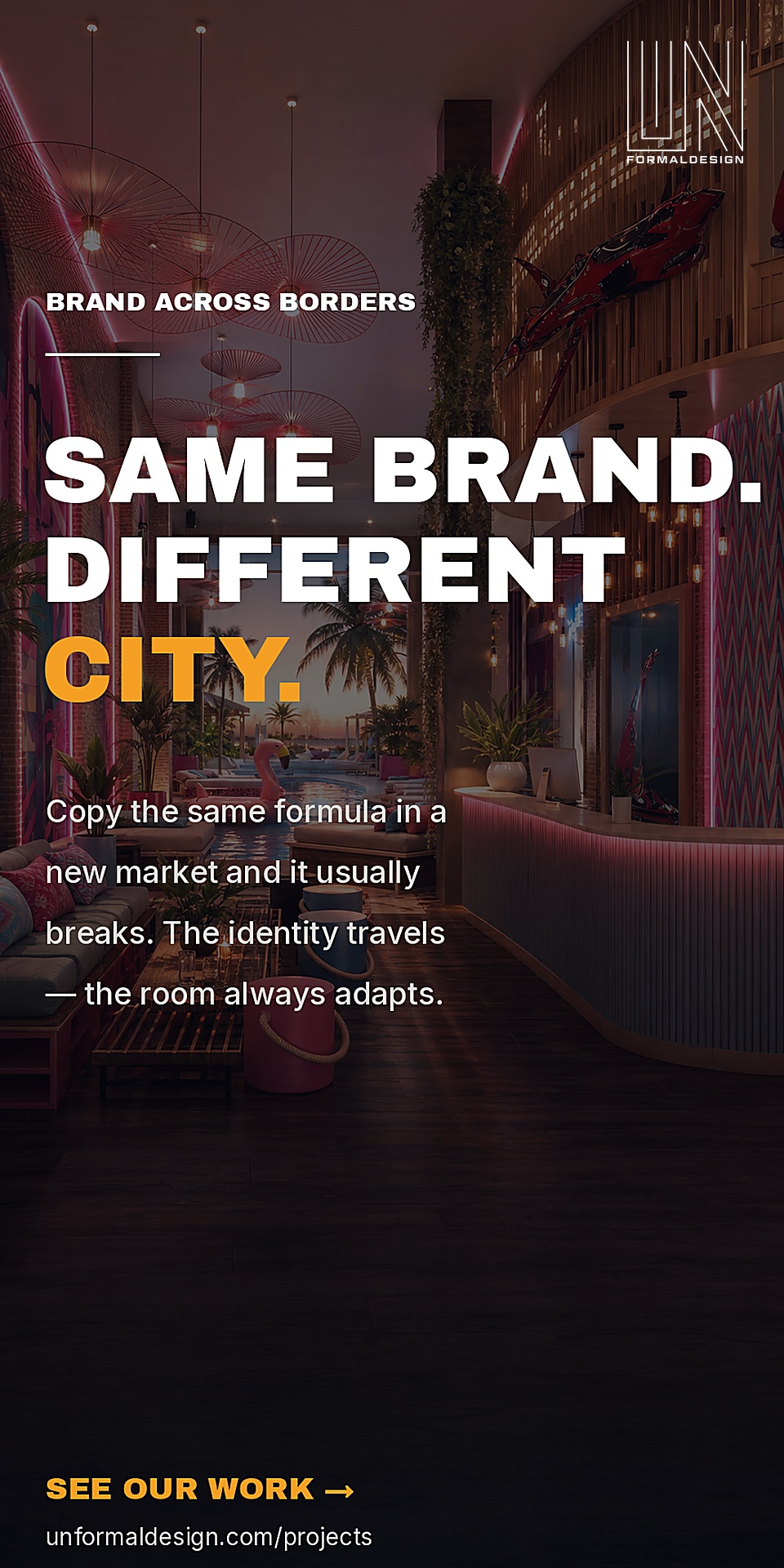
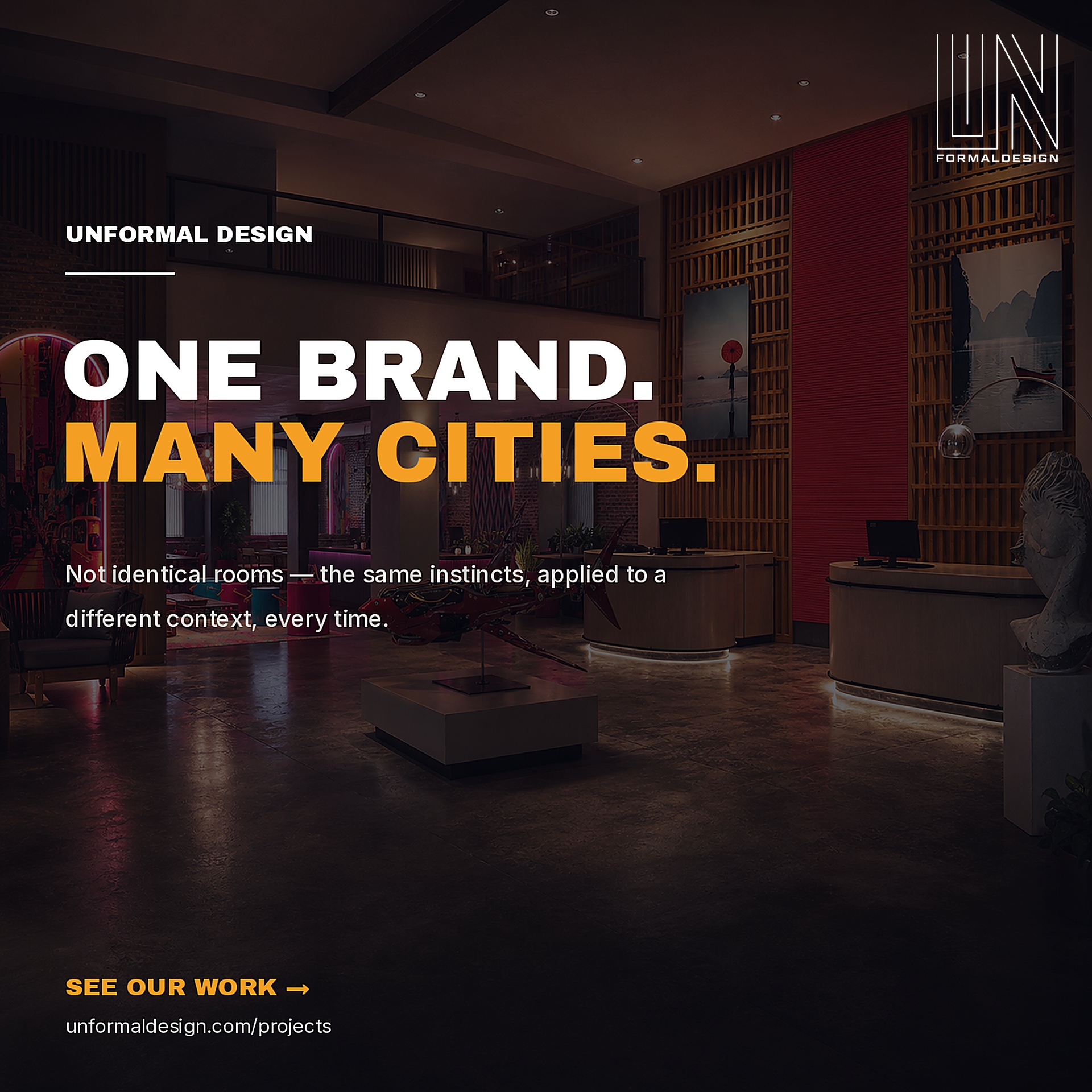
For NOMADS, the lifestyle hostel brand, that instinct is transition: every move between lobby, corridor, bar and lounge is designed as a mood shift rather than a passage. It holds at NOMADS Urban in Bangkok, at NOMADS Beach, and at NOMADS Urban Sydney — a 400-bed property for Collective Hospitality — even though the three rooms share almost no specification. The rebel character is the constant. Rattan on an island and raw urban surfaces in a city centre are both correct answers to it.
What must adapt — and the island case is the strictest
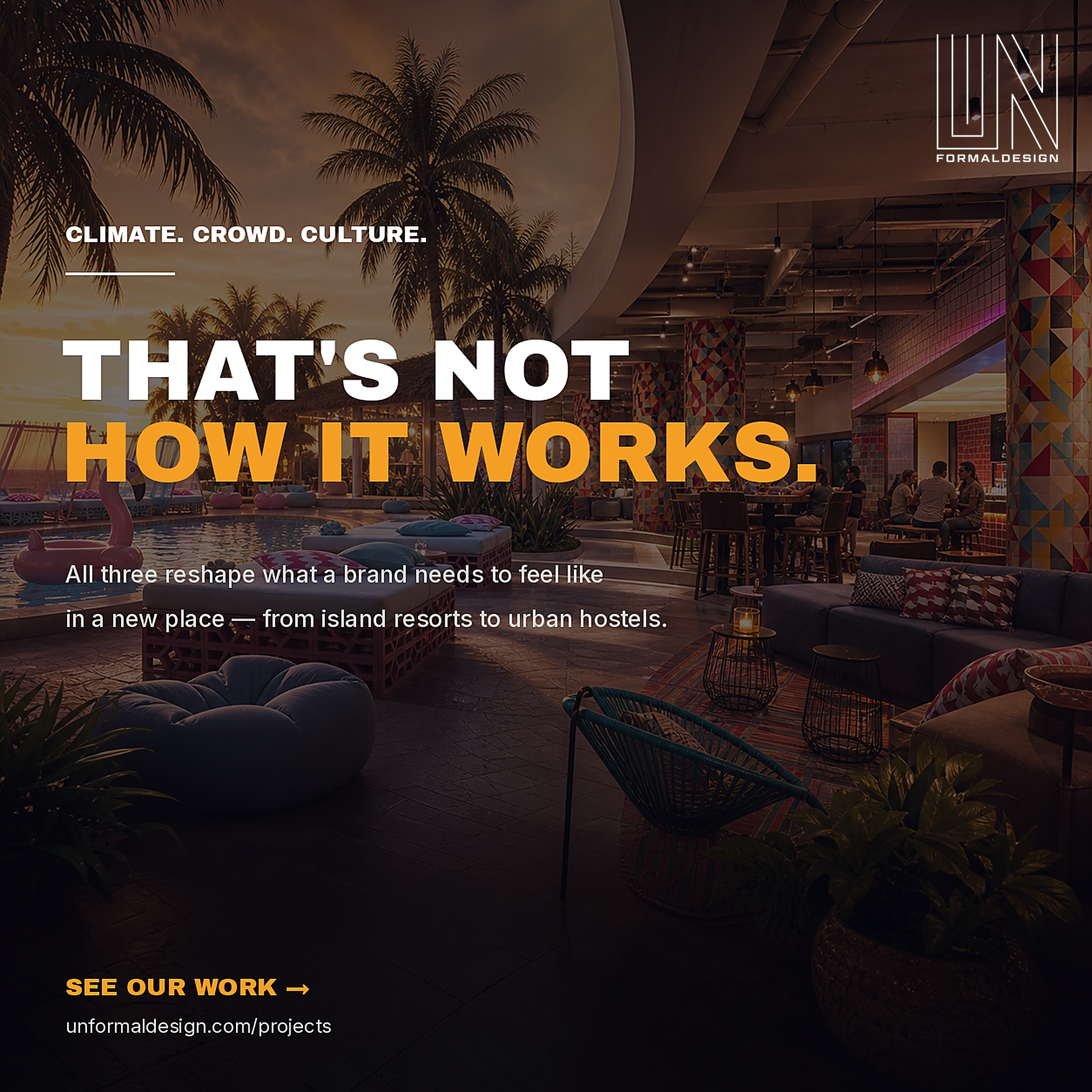
Climate is the variable that refuses to negotiate, and coastal projects are where it bites hardest. Salt air and humidity attack fixings, untreated metal and thin veneers on a schedule that has nothing to do with the design intent, so material choice on an island is a durability decision before it is an aesthetic one.
At Socialtel on Koh Samui, the brief was a beach club that works from day to night — two atmospheres in one envelope, in a coastal environment. At Radisson Red Phuket, roughly 10,000 square metres of lifestyle hotel, the requirement ran the other way: an international brand standard had to survive contact with a local identity without either side flattening the other.
| Context | Dominant constraint | Design consequence |
|---|---|---|
| Urban (Bangkok) | Floor plate and neighbours | Vertical thinking, acoustic control, compact circulation |
| Island (Koh Samui, Phuket) | Salt air, humidity, sun | Corrosion-resistant fixings, honest finishes that age well |
| International (Sydney) | Local crowd and regulation | Reprogrammed social zones, same brand instinct |
An honest limitation: a genuinely adapted second location costs more in design time than a copy of the first. What it saves is the rebuild eighteen months later, when the copied venue has been quietly corrected piece by piece.
How to brief a multi-site rollout
The useful brief is not a specification package to be repeated. It is a short statement of what the brand must feel like, plus a list of what each site is allowed to change. Studios that receive the second version deliver rooms that belong to the same family; studios that receive a copy-paste package deliver a weaker version of the first venue.
UNFORMALDESIGN works from concept through construction follow-up, which matters more on a rollout than on a single site — the local trades, materials and lead times are different in every market, and that is exactly where a specification quietly drifts. Project work is at unformaldesign.com/projects, and the studio can be reached at alessio@unformaldesign.com or +66 97 112 3561.
Frequently Asked Questions
Can you use the same interior design in two different cities? You can repeat the brand’s instincts — atmosphere, material tone, spatial hierarchy — but not the specification. Climate, local crowd behaviour and the building itself change in every market, and a package copied without adaptation usually needs correcting within the first two years.
What stays the same when a hospitality brand opens in a new market? The recognisable atmosphere and the spatial logic: where the social centre of the room sits, what the guest sees first, how light is handled, and how raw or refined the palette reads. Guests recognise a brand by feel far more reliably than by a specific finish.
Why do island and coastal hospitality projects need different materials? Salt air and high humidity corrode fixings and degrade thin or untreated finishes far faster than an inland urban environment. On coastal projects such as Socialtel on Koh Samui, materials are selected for how they age over years rather than how they photograph at opening.
Does a second location cost more or less to design than the first? Design time for a properly adapted second location is higher than a straight copy, but lower than starting from scratch, because the brand logic is already resolved. The saving comes later — an adapted venue avoids the piecemeal corrections that copied venues accumulate after opening.
Does UNFORMALDESIGN work outside Thailand? Yes. The studio is based in Thailand and works across Bangkok, Phuket and Koh Samui, and has delivered hospitality projects internationally, including NOMADS Urban Sydney for Collective Hospitality and a showroom project in Shenzhen.