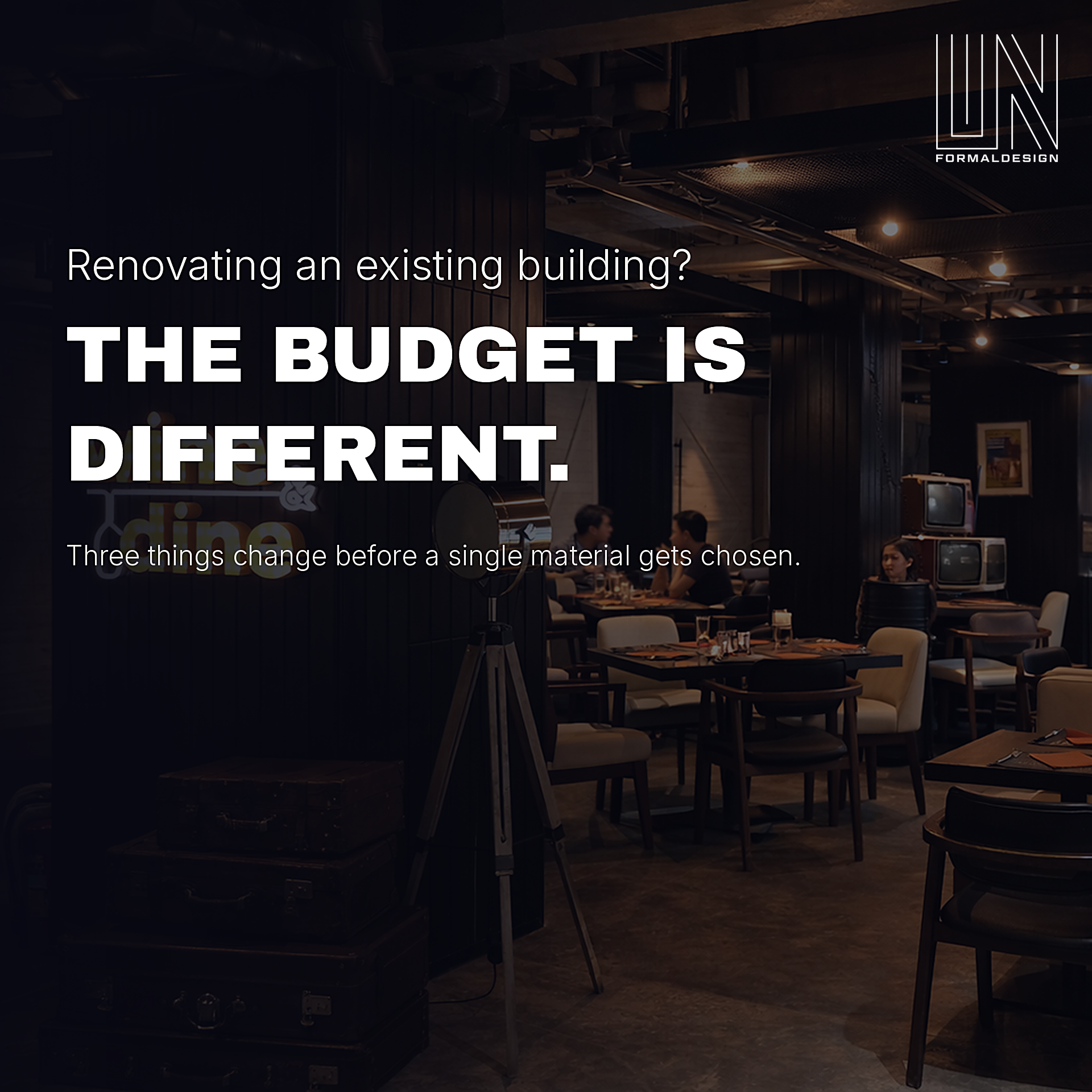



Renovating an existing building in Bangkok changes the budget conversation before a single material is chosen, because the cost of a retrofit is set by what the building already is, not by what the drawings say it will become. A new build starts from a known slab. A renovation starts from a structure with a history, and three things move at once: the contingency, the constraints and the way the job is priced. UNFORMALDESIGN, the Bangkok-based interior design studio led by Italian architect Alessio Carta, has delivered both new builds and adaptive reuse projects across Thailand, China and Vietnam, and this is how the studio frames that conversation with a client on day one.
Why a retrofit budget cannot be built like a new-build budget
A retrofit budget is a new-build budget with three extra lines: a larger contingency, a survey phase before design, and a sequence that allows for discoveries. Leave those lines out and the number on the first page is fiction.
The difference is not that renovations are always more expensive. Reusing a structure saves the cost of the structure. The difference is that the uncertainty sits in a different place. In a new build the risk is in the market: material prices, labour availability, lead times. In a renovation the risk is in the walls. Nobody knows exactly what is behind a 1980s shophouse ceiling until it comes down, and the budget has to say so in writing.
| What changes | New build | Existing building |
|---|---|---|
| Starting point | A slab and a set of drawings | A structure, its services and its surprises |
| Contingency | 5 to 10 percent of construction cost, as a common industry rule of thumb | 15 to 25 percent, because unknowns are physical, not just commercial |
| First phase | Concept design | Survey, then concept |
| Biggest cost driver | Finishes and fit-out | Structure, services and what has to be undone first |
| When the number firms up | At tender | After demolition, when the shell is exposed |
| Where the savings are | Efficient construction | Not building a structure at all |
Structural surprises are normal, not a red flag
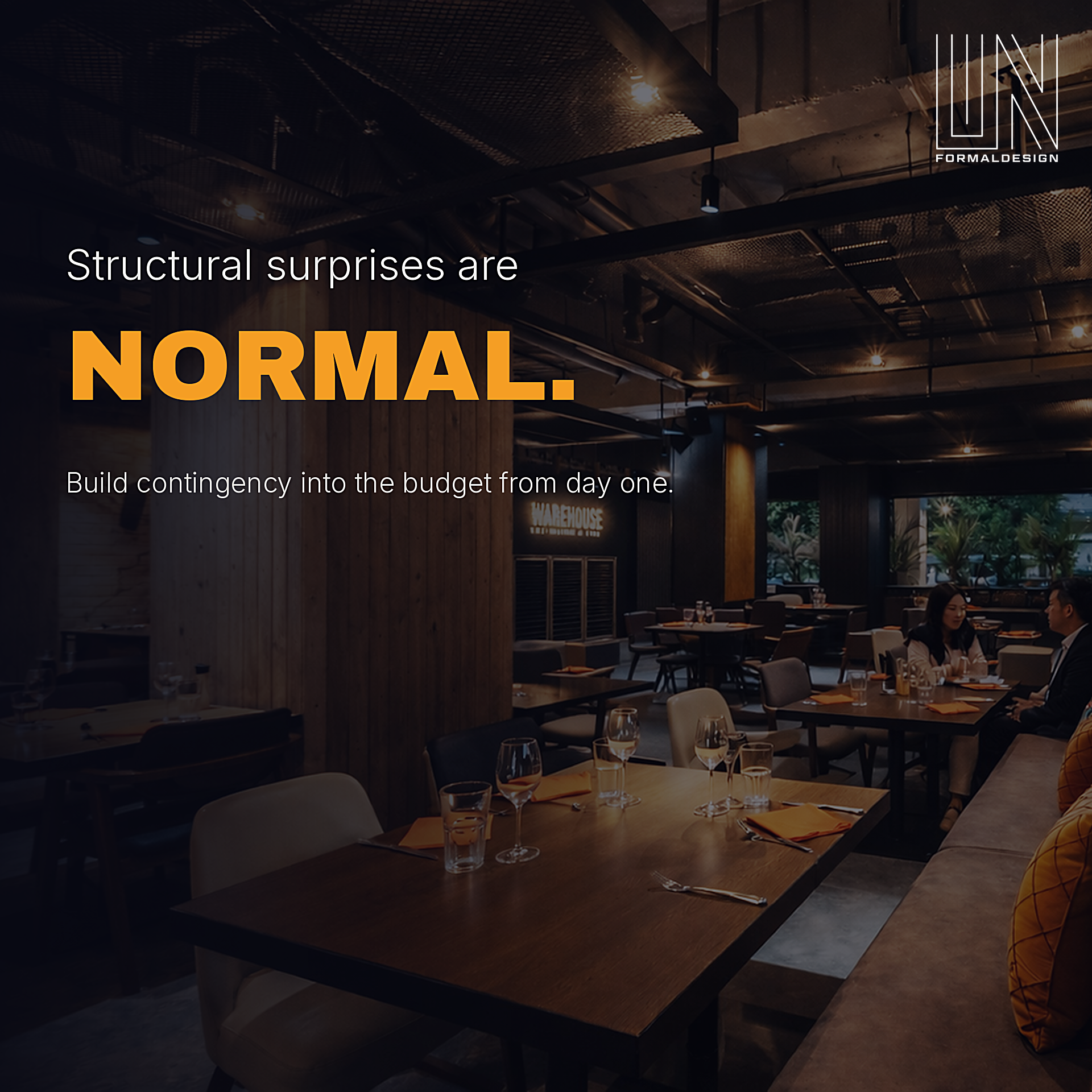
A structural surprise on a retrofit is a scheduled event, not an emergency, and the budget should treat it that way from day one. Cracked beams under a false ceiling, a load-bearing wall where the plan wanted an opening, drainage that runs the wrong way, an electrical board that cannot take a commercial kitchen: on an older Bangkok building at least one of these appears in nearly every project.
The wrong response is to treat each discovery as a crisis that reopens the whole budget. The right response is to have priced the possibility. That is what a contingency is for. A team that has opened enough ceilings knows roughly what fraction of the construction sum a building of a given age and type will consume in corrections, and books it before the first hammer.
At AILATI in Bang Rak, a 120 square metre wine bar, restaurant and pizzeria inside a Sino-European heritage building, the brief was to reveal the existing architecture rather than cover it. That decision moved money out of new finishes and into repair, cleaning and exposure of what was already there. The budget was structured around that trade from the start, so the surprises the building produced landed in a line that already existed.
Heritage constraints shape the concept before aesthetics do
Heritage constraints are design inputs, not design obstacles, and they should be on the table before the first mood board. A protected facade, a height limit, a window rhythm that cannot change, a staircase that must stay where it is: each of these decides part of the concept, and a studio that treats them as fixed points produces a better space than one that fights them.
Bangkok’s older commercial districts, Bang Rak and Charoenkrung above all, are full of buildings where the constraint is the value. An operator who buys into one of these is buying the facade, the ceiling height and the atmosphere. The concept has to grow out of those elements, and the budget has to fund their preservation rather than their replacement.
| Typical constraint | What it fixes | Budget consequence |
|---|---|---|
| Protected or historic facade | Entrance position, signage, window openings | Restoration line replaces new shopfront line |
| Existing ceiling height | Lighting strategy, mezzanine feasibility | Lower spend on ceiling build, higher on exposed services |
| Original floor or wall finishes | The material palette starts from what is there | Cleaning and repair instead of new surfaces |
| Structural grid | Kitchen and bar positions | Cost of moving services rather than walls |
| Existing services capacity | Kitchen size, HVAC load | Upgrade line that a new build would not carry |
Pricing the renovation of an existing building in Bangkok honestly
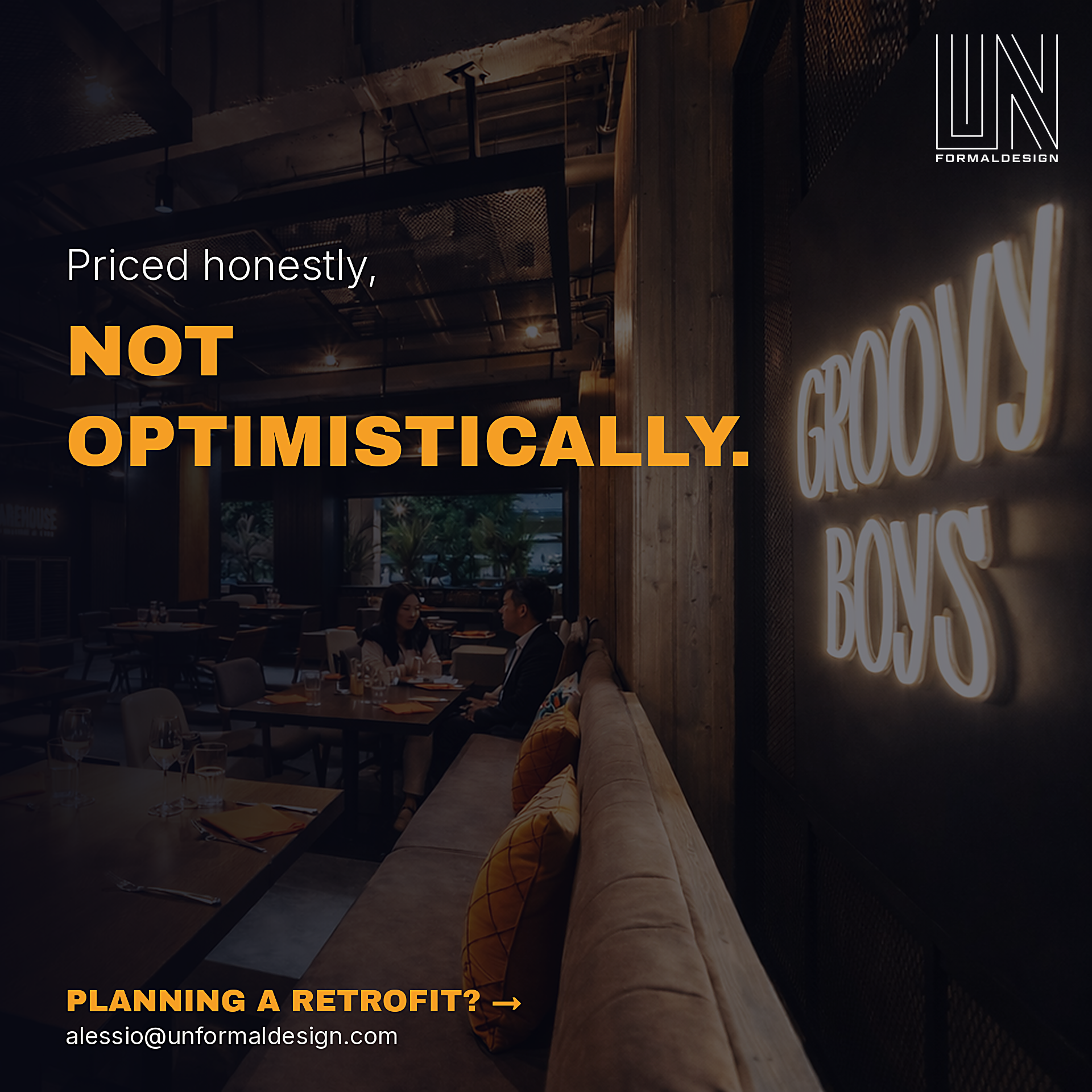
Honest pricing on a retrofit means a partner who has delivered both new builds and adaptive reuse prices the surprises in, and an optimistic quote is one that leaves them out to win the job. The second kind of quote is always cheaper on paper and always more expensive by opening day.
The practical test is simple. Ask how the contingency was calculated and what it is expected to cover. Ask which items in the estimate are provisional sums waiting for the survey. Ask what happened on the last three renovations the studio delivered when the ceiling came down. A team that answers with specifics has done this before. A team that answers with a lower number has not, or is hoping you will not check.
UNFORMALDESIGN’s own retrofit record in Thailand includes Socialtel on Koh Samui, a full rebrand and spatial redesign of an existing hospitality property, Warehouse Wine & Dine in Phuket, a 1,000 square metre F&B venue built around an existing industrial shell, and Ombra Modern Tavern in Bangkok, a 100 square metre existing shell at Seenspace Thonglor turned into a Venetian tavern through artwork and plaster rather than structural change. Outside Thailand the studio has worked inside existing buildings in Shenzhen and Hanoi. Each project priced the building it found, not the building the drawings wished for.
A note on search demand. Google Ads Keyword Planner data pulled on 14 September 2026 records no measurable monthly volume for “renovating an existing building in Bangkok”, “retrofit interior design Bangkok” or “adaptive reuse Thailand” in either Thailand or Bangkok. The question is asked in other words, usually to an assistant rather than a search box: “how much more should I budget for renovating an old building”. This page is written to answer that.
Working with UNFORMALDESIGN on a renovation
The first conversation about a retrofit should be about the building, not the look. For an existing building in Bangkok or elsewhere in Thailand, a shophouse, a warehouse, a heritage unit or a tired hotel, UNFORMALDESIGN can walk the site, structure the contingency and set the concept around what the structure allows. Reach the studio at alessio@unformaldesign.com or WhatsApp +66 97 112 3561.
Frequently Asked Questions
How much contingency should I budget when renovating an existing building? A common construction-industry rule of thumb is 15 to 25 percent of the construction cost for a renovation, against 5 to 10 percent for a new build. The older the building and the less documentation it has, the closer to the top of that range the contingency should sit.
Is renovating cheaper than building new in Bangkok? Often, because the structure already exists and does not have to be paid for. The saving is real but the uncertainty is higher: costs for structural repair, services upgrades and heritage restoration only firm up after demolition exposes the shell, so the budget must carry a larger contingency.
What are the most common surprises in a Bangkok retrofit? Hidden structural damage above false ceilings, load-bearing walls where a plan wanted an opening, drainage that runs the wrong way for a kitchen, and electrical supply too small for commercial equipment. At least one of these appears on most older buildings, which is why they are budgeted for, not feared.
How do heritage constraints affect an interior design budget? They move money rather than only adding it. A protected facade replaces a new shopfront line with a restoration line, original finishes replace new surfaces with cleaning and repair, and a fixed structural grid means services move instead of walls. The concept is built around these points from the start.
Has UNFORMALDESIGN worked inside existing buildings in Thailand? Yes. AILATI in Bang Rak sits inside a Sino-European heritage building, Warehouse Wine & Dine in Phuket occupies a 1,000 square metre industrial shell, Socialtel on Koh Samui was a rebrand of an existing property, and Ombra Modern Tavern in Bangkok reused a 100 square metre shell at Seenspace Thonglor.