

The promise of turnkey sounds simple: one partner, less friction, fewer surprises.
In practice, it only works if the design logic survives every handoff.
Otherwise “turnkey” just becomes a polite word for a process where lots of disconnected people touch the project and nobody really protects the atmosphere.
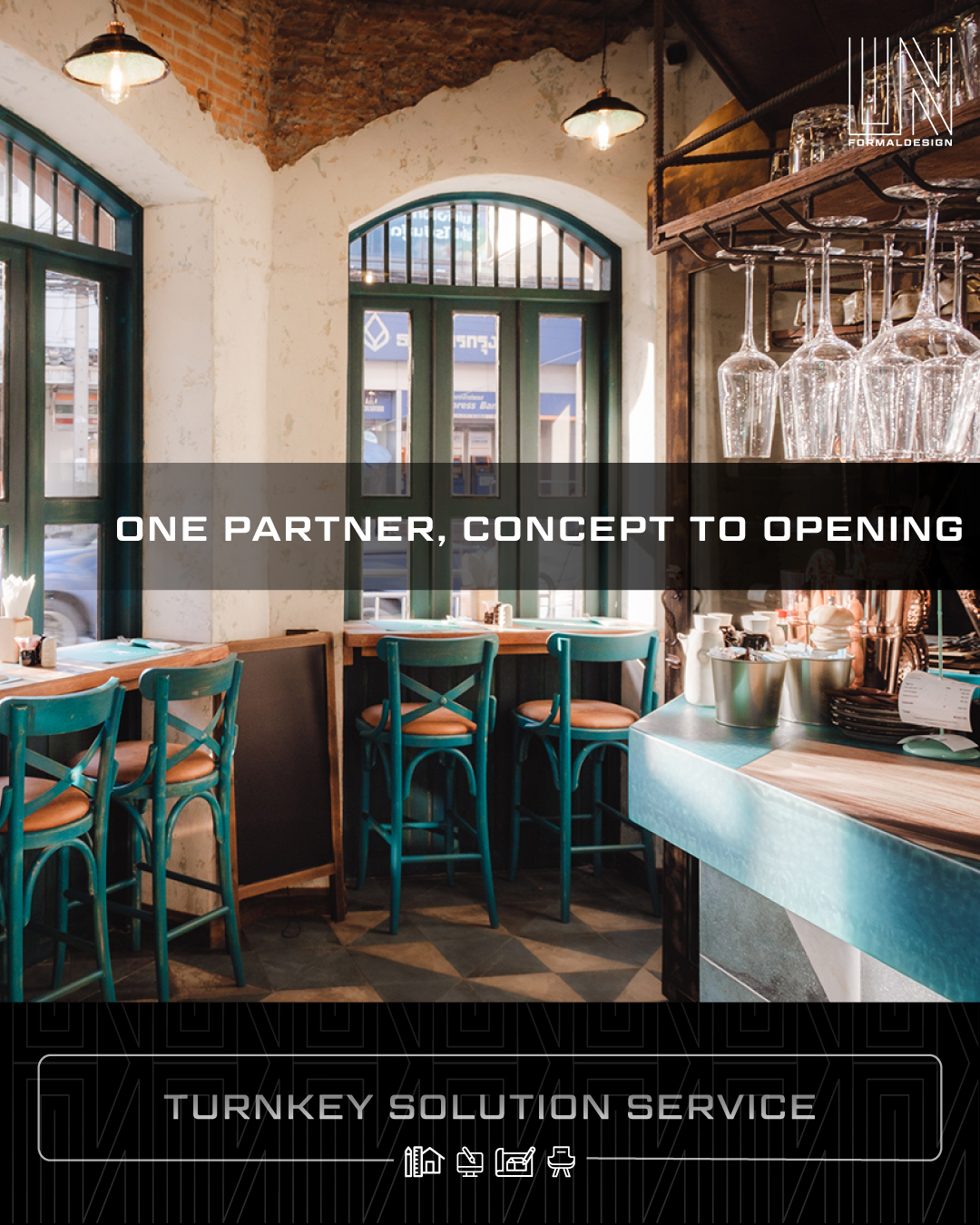
UNFORMALDESIGN takes the opposite view. Turnkey design solutions should mean one coherent vision carried from concept to opening—through materials, detailing, procurement, construction follow-up, and the final adjustments that make a room feel ready rather than merely finished.
About UNFORMALDESIGN: https://unformaldesign.com/about/ | Projects: https://unformaldesign.com/projects/ | Material System: https://unformaldesign.com/material-system/
That is what makes turnkey useful. Not convenience for its own sake, but coherence.
What turnkey should actually include
A real end-to-end approach usually means:
\- concept direction, so the room has a clear emotional and operational brief;
\- material system thinking, so the design language stays consistent;
\- procurement alignment, so the wrong item does not quietly flatten the whole mood;
\- construction follow-up, so site decisions do not erase what the concept promised;
\- final commissioning, where lighting levels, furniture, signage, and last details are tuned together.
If one of those pieces disappears, the result often looks “mostly finished” but never fully convincing.
Why operators ask for it
Hospitality projects generate a lot of friction by default. Timelines shift. Budgets tighten. Suppliers delay. Contractors propose alternatives. Somebody wants to save money on the exact item that was holding the room together.
A turnkey interior solutions approach helps because decisions stay connected.
That gives the client three real advantages:
- Faster decisions, because there is one logic behind them.
- Better budget clarity, because priorities are easier to protect.
- Stronger atmosphere, because the concept survives the messy middle.
That middle is where a lot of projects quietly lose quality.
Where turnkey usually fails
It fails when the process is treated like administration instead of design.
If the room becomes a checklist of procurement, installation, and delivery without someone protecting the emotional core of the space, the venue may still open on time—but it will feel generic.
That is why the design vision has to stay active all the way through. The turnkey value is not “we handled a lot of tasks.” The value is “the room still feels like itself at the end.”
What founders should ask before signing
\- Who controls design decisions once procurement starts?
\- How are substitutions approved?
\- What is included in the final fit-out and what is not?
\- Who checks site conditions against the concept?
\- When do lighting and atmosphere get tuned—before opening, or after someone notices it feels wrong?
Those questions usually reveal whether turnkey means real design continuity or just packaged convenience.
The useful way to think about it
A hospitality room is not complete when the furniture arrives. It is complete when the space feels coherent under real light, real sound, real circulation, and real operational pressure.
That last stage is where turnkey should earn its name.
Working with UNFORMALDESIGN
If you’re planning a hospitality, restaurant, bar, or lifestyle venue in Thailand and want one design vision carried from concept to opening day, message us.
\- WhatsApp: +66 97 112 3561 — https://wa.me/66971123561
\- Email: alessio@unformaldesign.com
Send the venue type, project stage, and whether you need concept only or end-to-end support.