

Expanded metal is usually asked to do very practical jobs: secure something, enclose something, keep people out, hold something in place.
Useful jobs. Not exactly atmospheric.
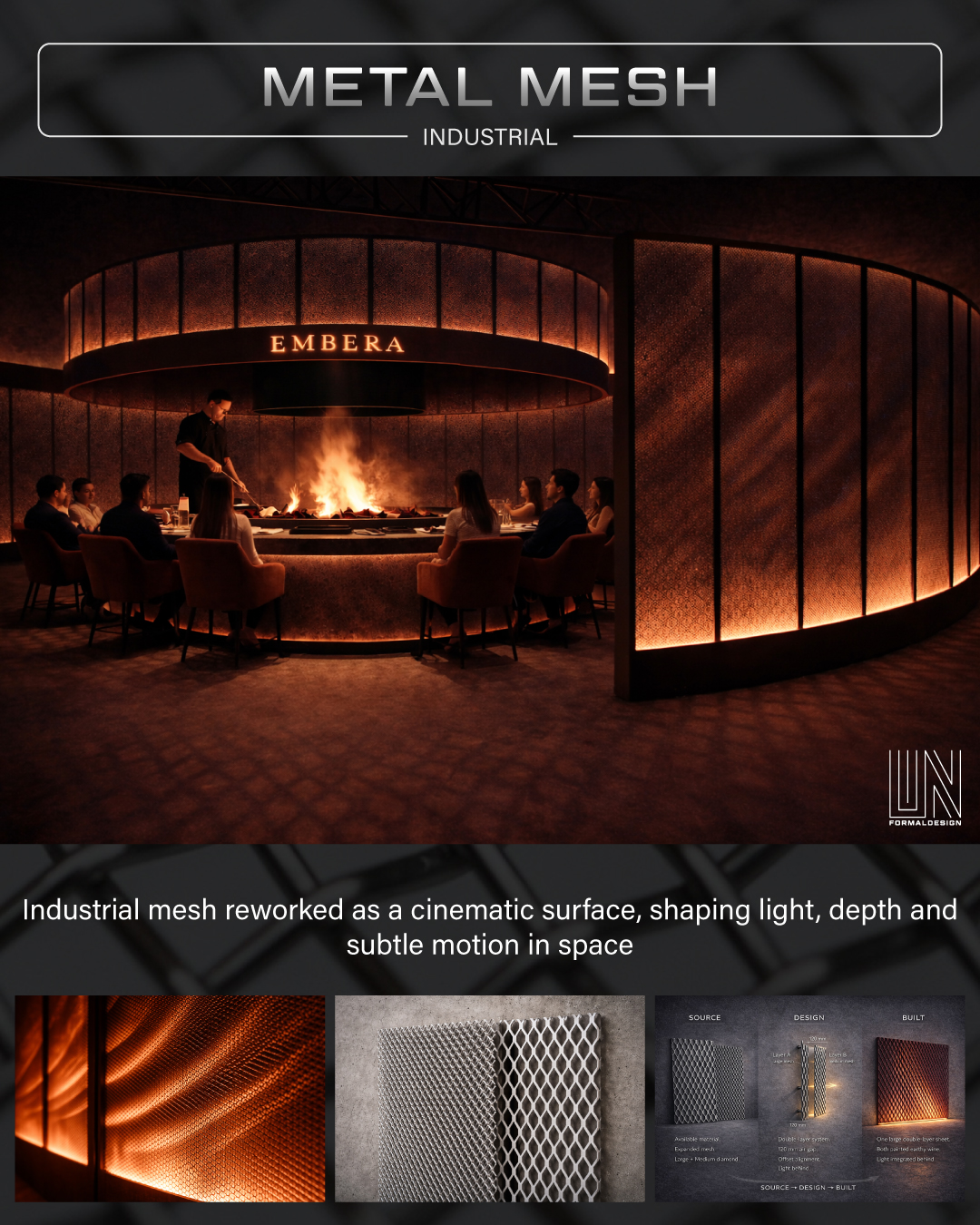
But when you layer the mesh properly, give it distance, and let light live inside the cavity, the material starts behaving very differently. It stops reading as a flat industrial sheet and begins acting like a cinematic surface.
UNFORMALDESIGN approaches it that way: not as a fence material dragged indoors, but as part of a material system design that can bring shadow, vibration, and warmth into a hospitality space.
About UNFORMALDESIGN: https://unformaldesign.com/about/ | Material System: https://unformaldesign.com/material-system/ | Projects: https://unformaldesign.com/projects/
Why the material works
The trick is not the mesh by itself. The trick is the relationship between layers.
Two expanded mesh sheets with different diamond scales, held apart with a controlled gap, create depth before you even add light. Once the geometries offset, the eye starts picking up a soft moiré shift. Move through the room and the pattern seems to breathe.
That is the point.
The surface should never feel purely graphic. It should feel alive because the atmosphere changes as the body moves around it.
What gives it presence
- Depth. The cavity between the layers makes the wall feel spatial instead of flat.
- Light. Embedded linear light can wash through the gaps and push the shadows beyond the surface itself.
- Scale. Different mesh sizes create vibration without relying on decorative add-ons.
- Restraint. The material is strongest when the proportions are tuned carefully and the rest of the room gives it space to work.
This is why industrial interior design materials become interesting only when they are treated with precision.
Where it can work best
\- as a backlit bar display with bottles and reflections hovering behind the grid;
\- as a feature wall where you want shadow and depth rather than a loud graphic panel;
\- as a ceiling band that pulls the eye through a circulation route;
\- as a divider that filters views instead of shutting them down.
In each case, the goal is the same: turn a cheap, tough material into a surface that feels immersive rather than utilitarian.
Thailand reality check
The benefit of expanded mesh in Thailand is obvious: it is durable, available, and naturally suited to heat and ventilation logic. But that does not mean the detailing can be lazy.
You still need to test:
\- whether the mesh edges are safe at body level;
\- how dust and cleaning affect the light quality;
\- whether the cavity depth is enough to create shadow without becoming bulky;
\- how warm light changes the metal finish across the day.
Otherwise the whole thing risks looking more like infrastructure than atmosphere.
What to think about before using it
If the room already has too much visual noise, mesh will make it worse.
If the room needs one strong plane of pattern, shadow, and industrial identity, mesh can do a lot with very little.
That is the real value: it creates richness through spacing and light rather than expensive complexity.
Working with UNFORMALDESIGN
If you’re planning a bar, restaurant, retail, or hospitality venue in Thailand and want to explore industrial materials without ending up with a cold room, message us.
\- WhatsApp: +66 97 112 3561 — https://wa.me/66971123561
\- Email: alessio@unformaldesign.com
Send the venue type, where the mesh would live, and whether the goal is warmth, depth, or a stronger nightlife edge.