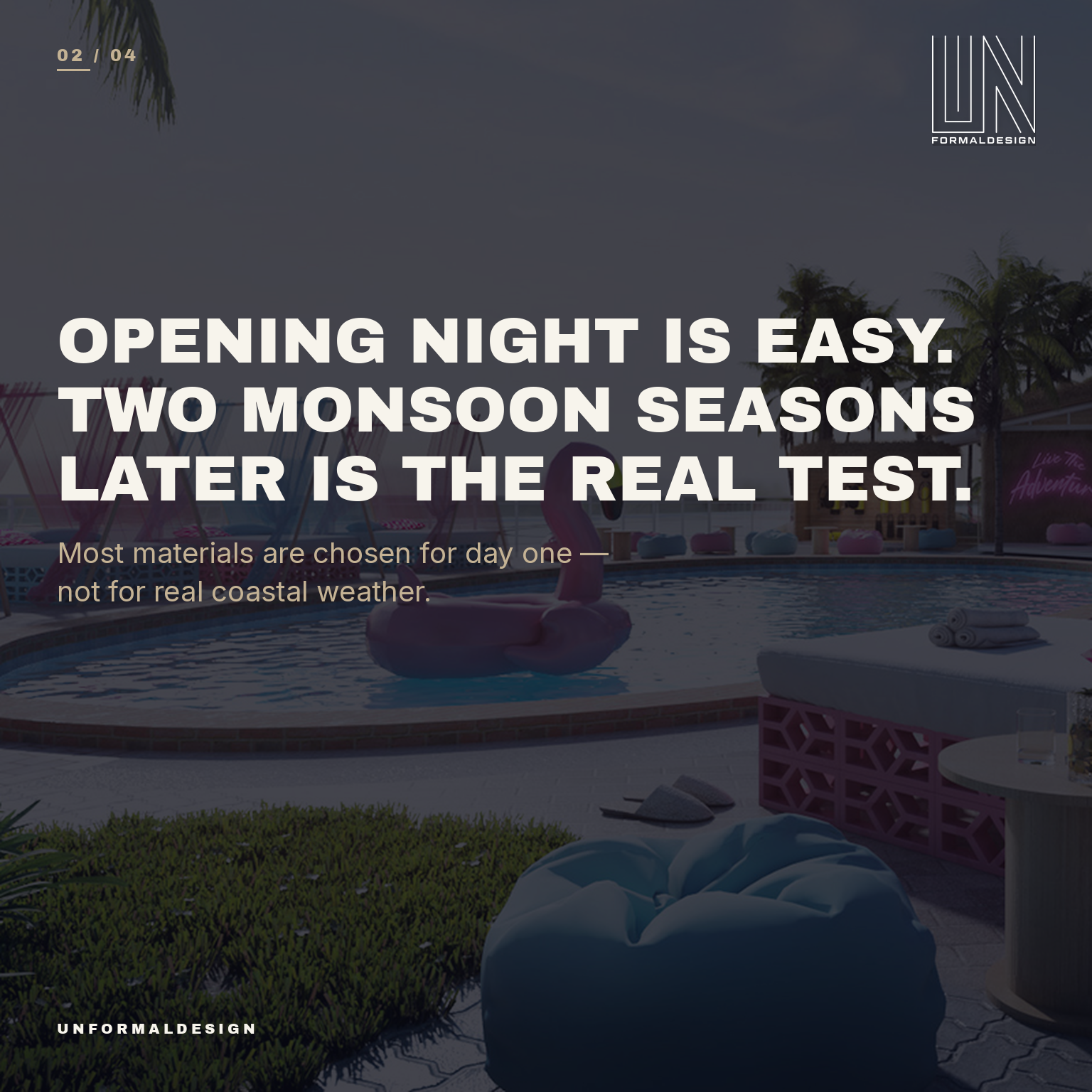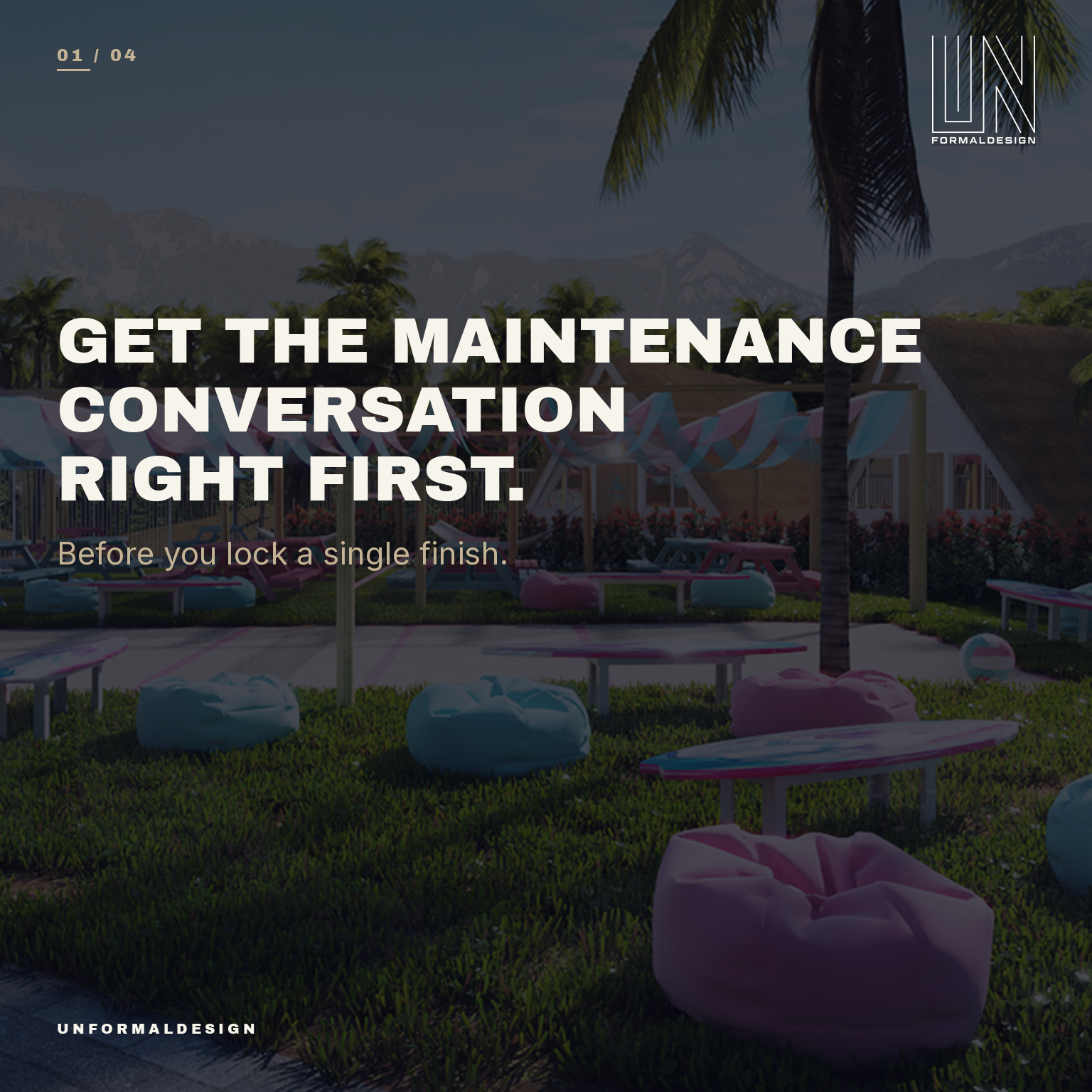



Most material decisions on a beach-town or island hospitality project get made for how they look at the ribbon-cutting. Almost none get made for how they perform after two monsoon seasons, a year of salt air, or the first time a finish needs repair without a specialist flying in. UNFORMALDESIGN is a Bangkok-based architecture and interior design studio led by Italian architect Alessio Carta, working on hospitality, F&B and retail projects across Thailand and the wider Asia-Pacific region, including coastal and island sites.
Coastal interior design maintenance in Thailand isn’t a finishing touch — it’s a budget line most operators discover the hard way, usually around month eight.
Why beach-town material lists fail on a different timeline than city projects
A material that performs perfectly in an air-conditioned Bangkok interior can fail fast in a coastal or island setting: constant salt air, high humidity, direct sun exposure and, on many sites, direct weather during storm season. The failure isn’t cosmetic — it shows up as swelling timber, corroding fixtures, delaminating veneers and finishes that need full replacement well before a city-based equivalent would.
The problem is that these failures are invisible on install day. A showroom sample and a finished space both look identical in week one. The gap only appears on-site, months later, which is exactly why it needs to be designed for upfront rather than discovered afterward.
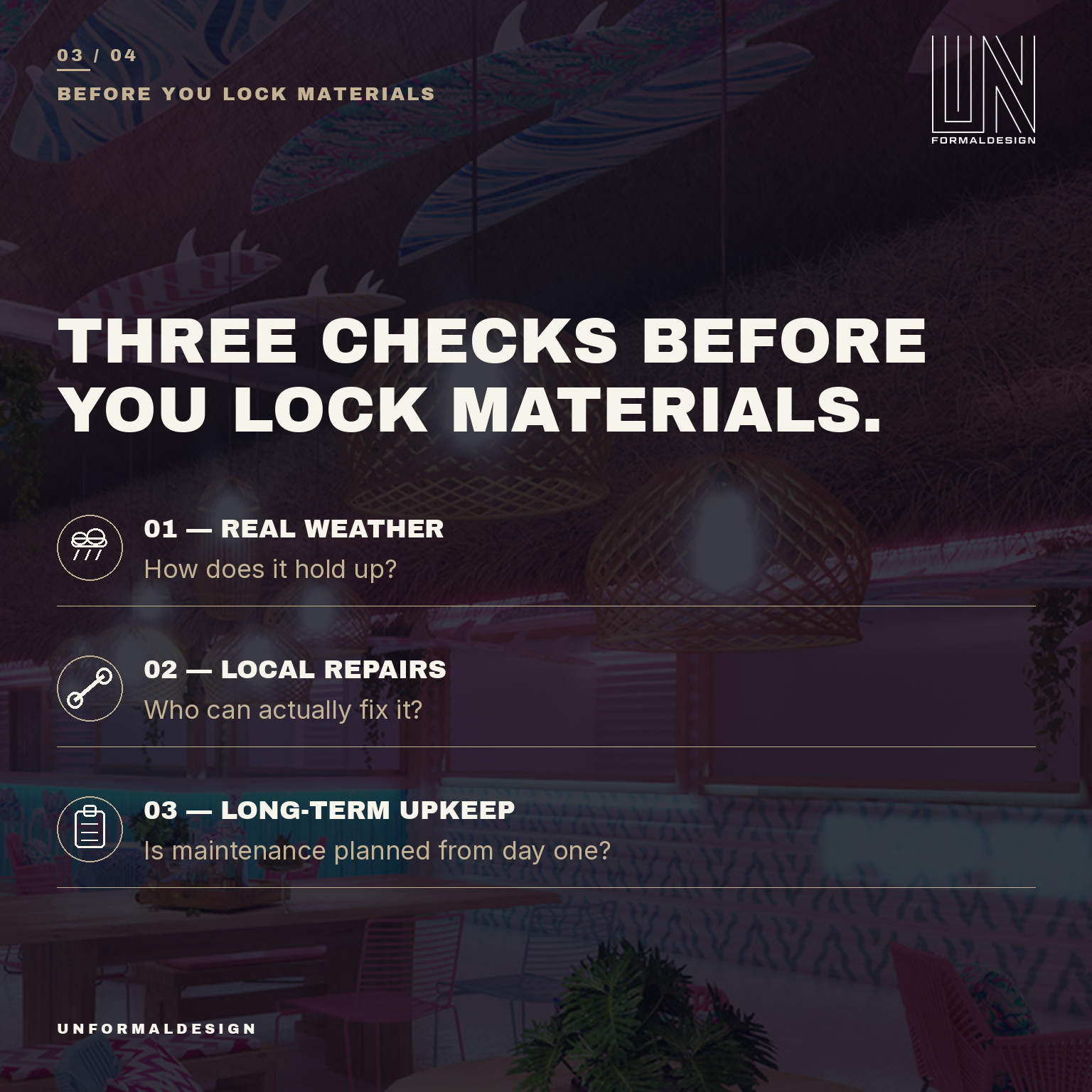
Three checks before locking a coastal material list
| Check | What it protects against | What gets missed without it |
|---|---|---|
| Post-weather performance | Judging a finish by install day, not year one | Materials chosen from renders or showroom samples alone |
| Local repairability | Margin erosion from specialist call-outs | A finish only one supplier, off-island, can service |
| Upkeep-first design partner | Ongoing cosmetic and structural decline | A partner optimizing for the opening photo, not the operating years |
None of these checks are visible in a rendering. They only surface in how a project is specified — which is the actual point of hiring a design partner rather than a decorator.
Who actually fixes it, and what that costs you
The single most underestimated line item on a coastal project is repairability. A stunning feature material sourced from a specialist supplier looks identical to a locally serviceable one — until something needs fixing. If the only person who can repair it has to fly in, every repair carries that flight, that day rate, and that downtime, on top of the materials themselves. Over a five-year operating window, that gap can outweigh the original material cost difference many times over.
Designing for local serviceability from the start — choosing finishes a regional contractor can genuinely maintain — is one of the highest-leverage decisions on a coastal project, and one of the least visible in a pitch deck.
Designing for the operating years, not the opening weekend
UNFORMALDESIGN works from concept through construction follow-up specifically because coastal and island projects diverge from their drawings the most — what a spec sheet promises and what a finish does after real weather are two different things, and the gap only closes with on-site accountability through the build. On Koh Samui, that discipline shaped material choices for Fria Nikkei and Silque, two coastal hospitality projects where humidity and salt exposure were part of the original brief, not an afterthought.
Planning a beach-town or island hospitality project in Thailand or Australia? The studio can be reached at alessio@unformaldesign.com or +66 97 112 3561, with past work at unformaldesign.com/projects.
Frequently Asked Questions
Why do materials fail faster on beach-town or island projects? Constant salt air, high humidity and direct sun exposure accelerate wear on materials that would perform fine in a standard city interior. The failure is often invisible on install day and only shows up months into operation.
What’s the biggest hidden cost in coastal hospitality material selection? Repairability. A material only one specialist, often off-island, can service turns every future repair into a flight, a day rate and downtime — costs that compound over the life of the project.
Should coastal projects use completely different materials than city projects? Not necessarily different materials — different selection criteria. The same material can be specified with weather- and humidity-rated finishes, or paired with a local repair plan, rather than swapped for something generic.
Does UNFORMALDESIGN work on island and beach-town projects outside Thailand? Yes. The studio has delivered island and beach-town hospitality projects across Thailand and Australia, applying the same maintenance-first material logic on every coastal site.