


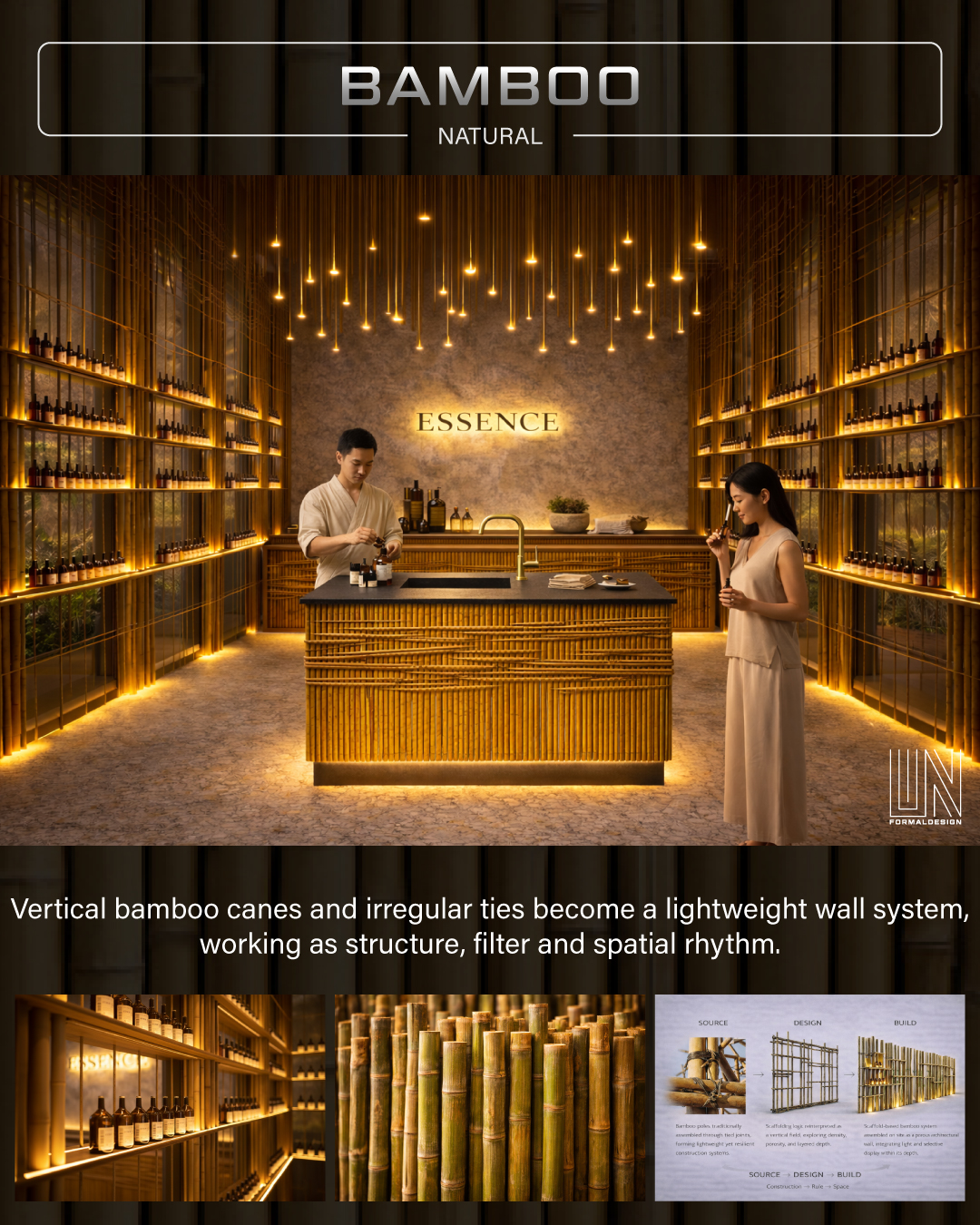
Bamboo scaffolding is not a borrowed image or decoration; it is the starting point for a wall system that reads as structure, screen, and atmosphere at once. When we trace the cane up the wall we are tracing the gesture of craftsmanship, the rhythm of a skyline, the tension of a space that is asking to be both porous and private. The system arrives from the street where scaffolding wraps buildings like film, and we lean into that raw, honest moment instead of disguising it. Its assembly becomes choreography borrowed from crews that build, dismantle, and move on the same day.
In the Asian cities where UNFORMALDESIGN works the scaffolding is the city breathing; it is always visible outside shopfronts, always moving, always spatial. We reframe that ephemeral language into hospitality interiors in Thailand because bamboo has a cadence that can hold art, light, and people without pretending to be tame. We keep the irregular ties, sawn-off lengths, and patched-in details—the imperfections become the grammar. The bamboo wall reads as a story from the scaffolding outside, so the space feels familiar despite being deliberately designed.
About UNFORMALDESIGN: https://unformaldesign.com/about/ | Material System: https://unformaldesign.com/material-system/
Internal link placements: material system approach → https://unformaldesign.com/material-system/ | built hospitality interiors → https://unformaldesign.com/projects/ | UNFORMALDESIGN in Thailand → https://unformaldesign.com/about/
At its core, this is a bamboo wall system hospitality Thailand venues can actually use—not as decoration, but as a porous interior screen that manages light, circulation, and identity. For restaurants, bars, and boutique hotels in Bangkok or the islands, the value is in turning a familiar street material into a serviceable hospitality feature wall with real atmosphere. In practical terms, it gives teams a way to test bamboo scaffolding interior design as a working partition system rather than a visual gimmick.
Bamboo scaffolding as architectural grammar
This wall system has rules: pitched ribs, deliberate offsets, and tolerances for movement. Those rules make it repeatable, serviceable, capable of carrying shelves, light fixtures, signage, and plant insertions. We treat each cane as a conductor of light and air rather than a load-bearing member, which means the wall can be demountable, reconfigurable, and easy to repair. The grid becomes a porous field that filters light and defines space without closing it.
Calibration moves at a glance:
– Consistent pitch with deliberate offsets keeps the rhythm readable even under strobes or sunshine.
– Irregular ties and layered depth create shadow and texture without descending into chaos.
– Modular spacers allow shelves, signage, or displays to plug in without new embedments.
– Mixed bamboo species create tonal gradients that shift with daylight and service energy.
– Hidden mechanical channels carry wiring and low-voltage runs without disturbing the surface.
– Structural anchors align with the service loads so the wall feels solid and intentional.
Porosity, rhythm, and service
The wall breathes. Some sections are dense, creating compression that announces arrival; others are open, inviting glimpses into the kitchen or the street. The irregular shadows become part of the atmosphere, and we calibrate the lighting so the gaps glow instead of disappearing into darkness. Density, voids, and rhythm are tuned to frame views, filter entrance, and manage the rush of service. Insertions—floating shelves, display niches, counters—plug into the bamboo grid without dismantling it. These insertions can be theatrical or pragmatic, depending on the night and the vibe.
Operational pauses we choreograph:
– Dense ribs near the bar form a tactile curtain that heightens the reveal once guests step past it.
– Perforated areas align with staff paths so circulation remains open even when the row is busy.
– Hidden framing makes neon, signage, or plantings easy to attach without new drilling.
– Bamboo modules can angle outward for acoustic control in loud sections or inward for intimacy.
– The grid doubles as a service wall for lighting, audio, and AV, so electricity doesn’t clash with craft.
Material system and resilience
We treat the bamboo scaffolding wall as part of our broader material system so the same language can appear across projects. The modules can repeat in hotel lobbies, restaurants, or pop-ups, keeping the intent constant while letting the surface evolve. Bamboo is fast-growing, locally available, and forgiving; we oil it, paint it, or leave it raw depending on the tone. Scratches and patina are not accidents—they become signals of craft and city energy. The approach is documented so future builds can borrow the logic without copying the exact look—see the modular references at https://unformaldesign.com/material-system/.
Why this matters for Thai operators
For hospitality operators in Thailand, a bamboo scaffolding wall is more than a visual move. It can help a compact room feel layered without making it heavy. It can filter a dining zone from a service run, hold visual interest during the day, and become more dramatic once the lighting scenes shift at night. It also gives the venue something that many polished interiors lack: a relationship with the real city outside. That relationship matters when brands want to feel local without becoming cliché.
We also like bamboo because it rewards human craft. The joins can be tuned by hand. The grid can be adjusted on site. The surface can become more precise or more relaxed depending on the operator’s tone. That gives the design enough control to be refined, while still leaving room for life. In the best projects, guests do not read the wall as a “concept.” They simply feel that the room has rhythm, air, texture, and character.
If you want a hospitality surface that feels like the city breathing inside the venue, start the conversation now. WhatsApp: https://wa.me/66971123561 | Email: mailto:alessio@unformaldesign.com