

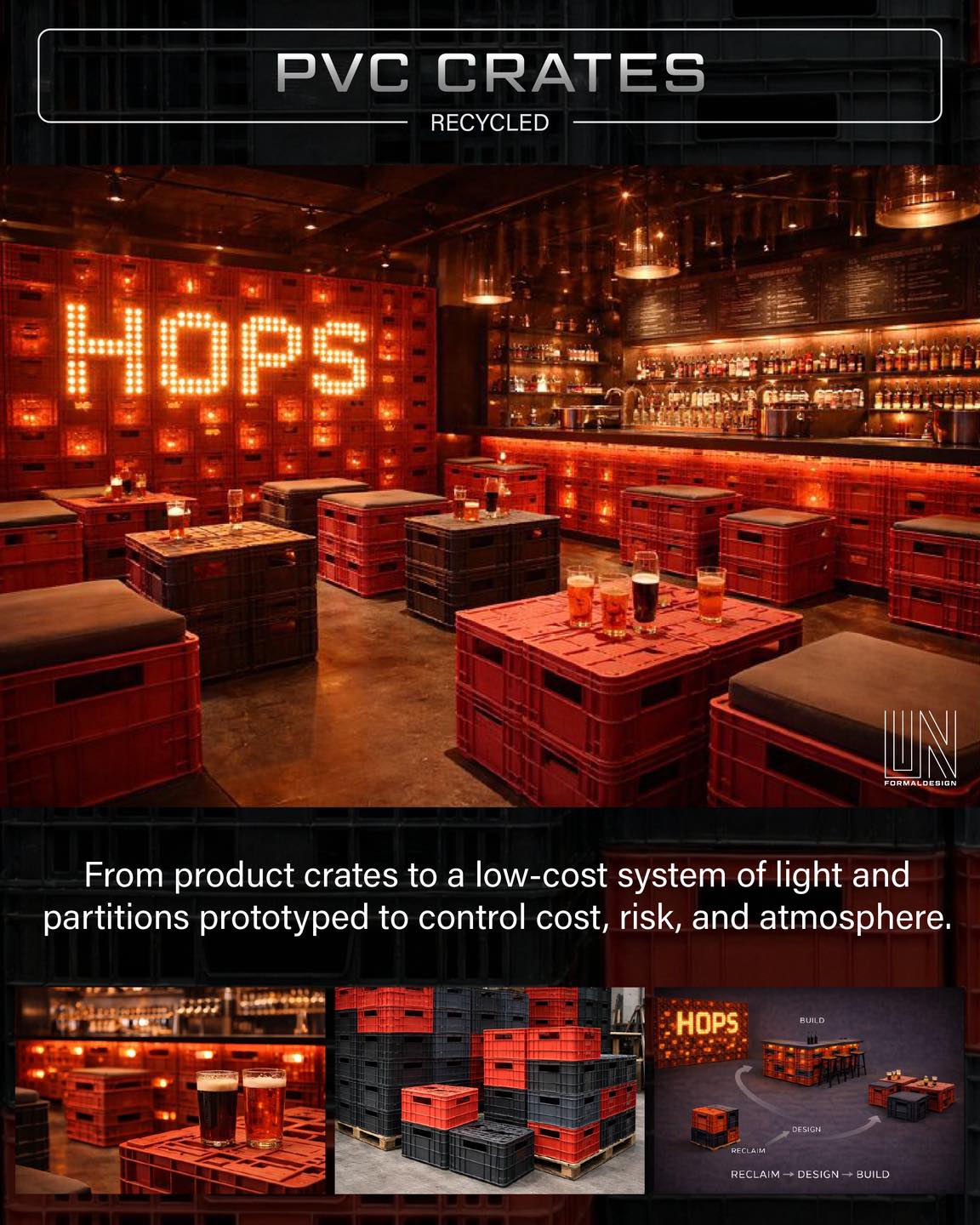
PVC crates are built for storage and distribution. That’s exactly why they’re interesting for interior design: they already understand load, repetition, and logistics.
The Design Advantage: Perforation = Light + Shadow + Rhythm
The crate’s perforated geometry lets light pass through, colour bleed across surfaces, and shadow create depth. This turns an inexpensive industrial object into atmosphere.
5 Buildable Applications (F&B-ready)
Bar Front / Bar Back Rhythm
Stack crates in a repeatable grid. Add selective reinforcement where load and impact happen.
Illuminated Partitions
Backlight the grid. The perforation filters glare and creates secrecy—perfect for nightlife zones.
Seating and Banquette Bases
Use crates as a structural base, then add refined cushions. Raw structure, refined comfort.
Feature Walls with Graphic Density
Vary orientation and colour. Keep a controlled logic so it reads as system, not clutter.
Ceiling Bands / Hanging Elements (careful)
Treat as a real ceiling element: fixings, weight, maintenance access, fire strategy.
Material System Inquiry
• Want a modular material system (pallet / PVC crate / barrel / bottle / rattan)?
• Tell us your venue type + climate exposure + budget tier.
FAQ
Q: What is the one thing that makes a hospitality interior memorable?
A: A clear feeling, expressed through light, material, and movement.
Q: How do you design for Thailand conditions?
A: Durable materials, refined touchpoints, ventilation/maintenance access, and lighting that works at low lux.
Q: What do you need to quote a project?
A: Location, approximate area, venue type, scope, timeline, and constraints.