

If your hospitality space is “perfect,” it can still be forgettable.
The rooms are clean. The joinery is sharp. The renders look expensive. And yet… no pulse. No friction. No story. No reason for people to come back.
UNFORMALDESIGN sits between structure and chaos—a lifestyle design studio for hospitality + F&B in Thailand. We take raw energy (street life, patina, bold color, honest material) and shape it into something refined enough to operate—and alive enough to be remembered.
This isn’t a manifesto for messy design. It’s a framework for building experiential interior design: spaces that hold people, move them, and quietly sell the brand without screaming.
What “experiential Interior Design” Actually Means (in Hospitality)
Experiential interior design is designing the space around what a guest feels and does—not just how it photographs.
In hospitality and F&B, the “experience” is not a slogan. It’s:
- How light hits the first surface you see when you walk in
- How sound changes as you move deeper into the space
- How the bar face becomes a stage, not a counter
- How materials age under hands, heat, humidity, and spills
- How the layout supports rhythm (arrival → pause → release)
A space can be minimal and still experiential. It can be industrial and still warm. The point is not a style—it’s a sequence.
Our Positioning: Structure + Chaos (not Corporate Perfection)
There’s a type of “commercial perfection” that looks premium and feels dead.
Everything is controlled. Every edge is safe. Every choice is designed not to offend. The result: a place that works, but doesn’t connect.
UNFORMALDESIGN rejects that.
We start from the human side:
- Street vibe: real color, real texture, real life
- Industrial honesty: materials that show how they’re made and how they age
- Vibrant energy: atmosphere with tension (not beige comfort)
- Refined execution: it still needs to be buildable, maintainable, and profitable
Our definition stays simple:
Design is not formal. It is unformal. Raw, refined, alive, emotional.
A Practical Framework: 5 Layers of Brand Experience
If you’re an operator in Thailand—Bangkok, Phuket, Chiang Mai, islands—this is how to translate brand into space without turning your venue into a billboard.
The Signal (what People Feel in the First 10 Seconds)
Guests decide “this is my place” almost immediately.
The signal is built with:
- Entrance compression or openness
- Lighting contrast (dark-to-bright, bright-to-dark)
- The first dominant texture (plaster, brick, metal, timber, fabric)
- A single non-negotiable brand cue (color, graphic rhythm, object)
Rule: Pick one bold move and make it real. Not a sticker.
The Rhythm (how the Venue Moves Over Time)
Hospitality is time-based design. Lunch is not dinner. Early drinks are not peak-night.
We build rhythm using:
- Zoning (quiet edges, loud core)
- Seating variety (perch / lounge / group / solo)
- View corridors to “anchor points” (bar, kitchen pass, DJ, feature wall)
Structure is what makes chaos usable.
The Friction (small Tension That Creates Memory)
A memorable venue has controlled friction:
- Rough vs smooth
- Dark vs neon
- Patina vs precision
- Old object used in a new way
The goal isn’t discomfort. It’s identity.
The Craft (the Human Layer)
Thailand has incredible makers and site teams—if you design for them.
Craft shows up in:
- Hand-troweled plaster that catches light differently every hour
- Painted surfaces with imperfect edges (alive, not printed)
- Joinery that embraces texture instead of hiding it
Craft is the opposite of “generic luxury.”
The System (materials + Modules You Can Replicate)
If you plan to expand, the space needs a repeatable system.
This is where UNFORMALDESIGN’s material system approach becomes a business tool:
- Modular components
- Reusable details
- Flexible partitions
- Scalable feature elements
Not copy/paste. A system that can adapt.
Why This Works for Hospitality + F&B in Thailand
Thailand is not a neutral backdrop.
- Heat, humidity, salt air, and heavy use will destroy fragile “luxury” fast.
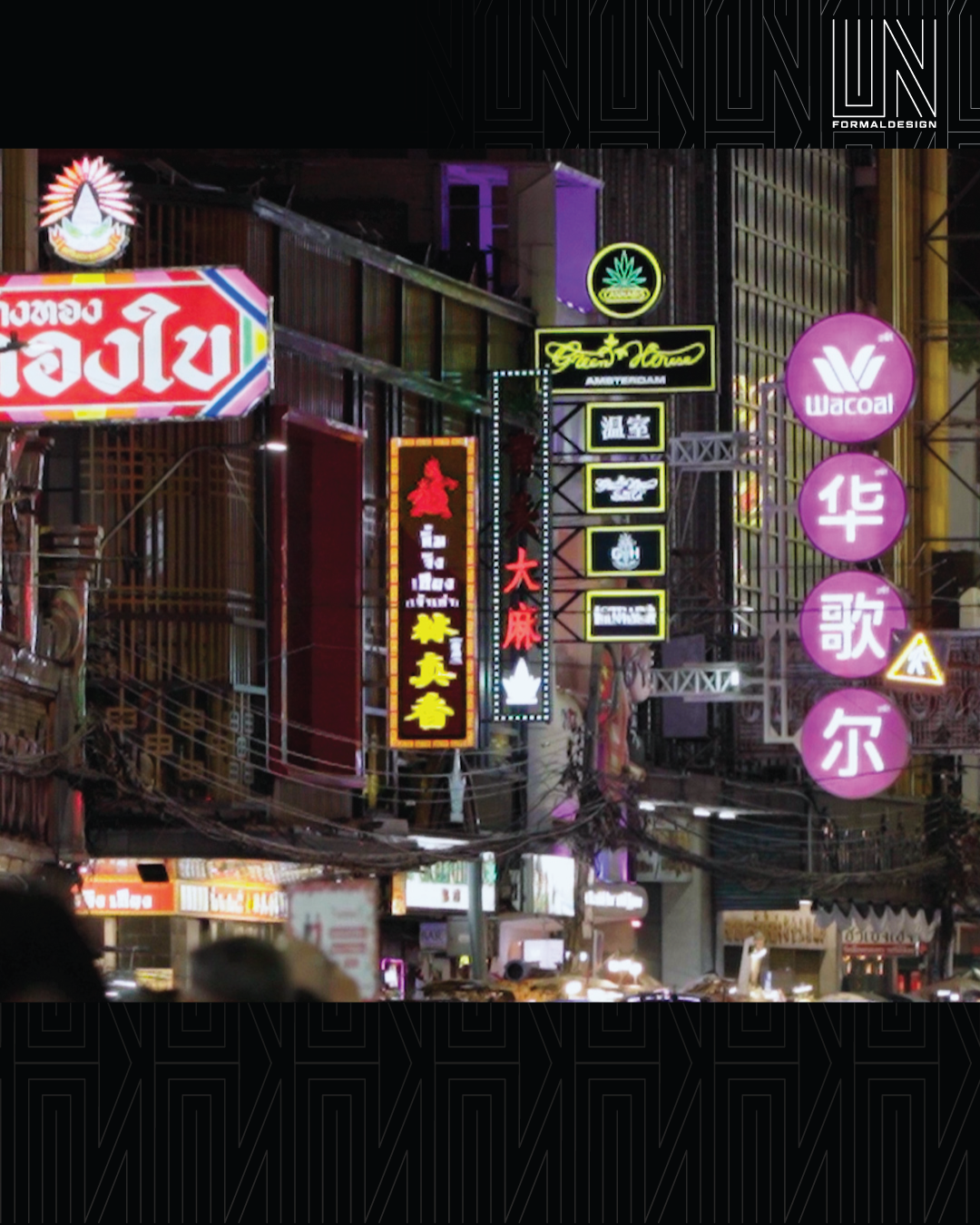
- Guests are visually literate—Bangkok alone is a masterclass in texture, signage, and contradiction.
- The competition is intense: atmosphere is often the differentiator.
A positioning that’s raw but refined fits the reality: it respects the city and doesn’t pretend to be elsewhere.
What to Ask a Design Studio Before You Hire Them
If you’re shortlisting an interior design company in Bangkok/Thailand, ask questions that reveal their process—not just their portfolio.
- How do you design atmosphere (light, sound, material) before décor?
- What is your approach to durability in tropical climates?
- How do you translate brand into a spatial sequence (not just a logo wall)?
- What can be modular and reusable so future changes don’t cost a fortune?
- Show me one project where the “imperfect” choice made the space stronger.
A Quick Example: “structure + Chaos” in One Corner of a Bar
Imagine a 2.5m section of wall behind a bar station:
- Structure: a clean, rational back bar layout (storage, speed rail, undercounter, service path)
- Chaos: the wall surface is a textured field—reused modules, layered paint, or industrial material rhythm
- Refined: lighting is placed with precision so the chaos reads as intentional
That single corner can carry the brand harder than any marketing line.
Working with UNFORMALDESIGN
If you’re building or renovating a hotel, restaurant, café, or bar in Thailand and you want a space that feels industrial, vibrant, human—without falling into “commercial perfection”—we can talk.
Send:
- Your location + venue type
- A rough floor area
- One reference that matches the mood (not the style)
We’ll reply with questions and a clear next step.
Strategy Call
• City + location
• Venue type
• Rough floor area
• Opening timeline
FAQ
Q: What is experiential interior design in hospitality?
A: Designing the guest experience—light, sound, movement, touchpoints—not only the look.
Q: How do you balance raw materials with durability in Thailand?
A: Use raw texture where it sells atmosphere, refine touchpoints, and engineer maintenance access.
Q: What should I send to start a project?
A: Location, venue type, rough area, timeline, and one reference for energy (not style).